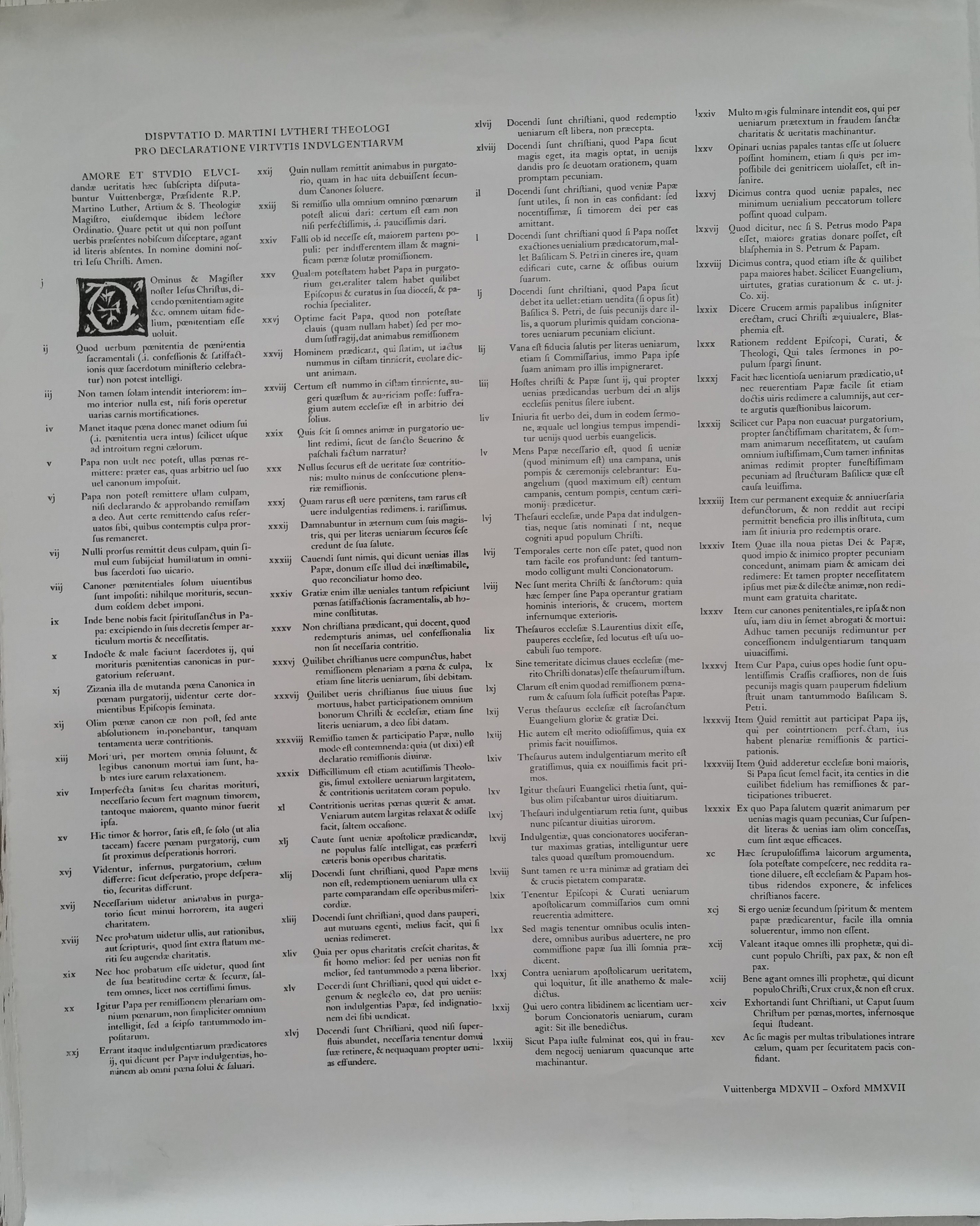
Facsimile
Transcription
Out of love for the truth and a desire to bring it to light, the following will be debated at Wittenberg under the Reverend Father Martin Luther, Master of Arts and Theology, and Official Lecturer in Theology there. He therefore requests that those unable to debate in person should, in their absence, do so in writing. In the name of our Lord Jesus Christ. Amen.
1 When our Lord and master Jesus Christ said, ‘Do penance’, etc., he meant the whole life of the faithful to be penance.11 ‘Penitentiam agite’ (‘Do penance’) is a quotation from Matthew 4: 17 in the Vulgate. As Luther makes clear in the Explanations, the Latin is a translation of the Greek μετανοεῖτε, which comes from a verb meaning ‘to change one’s state of mind’ (it is likely that Luther found this in Erasmus’s annotations to his 1516 edition of the Greek New Testament). Luther’s point in theses 1 and 2 is that penance should be viewed as a change in one’s way of life rather than as the performance of discrete acts. The KJV comes closer to capturing the sense Luther has in mind with ‘Repent’.
2 This word cannot be understood to refer to sacramental penance (that is, confession and satisfaction as administered by the clergy).22 See Sermon, paragraph 1 and Introduction.
3 Nor, however, does it mean only inner penance: on the contrary, inner penance is worthless unless it manifests itself in various mortifications of the flesh.33 The idea that penance has both an inward and an outward manifestation was not new in Luther’s time: it occurs in the writings of Peter Lombard (see Sermon, paragraph 1).
4 And so punishment lasts for as long as hatred of the self (that is true inner penance), in other words, until entry into the kingdom of heaven.44 For self-hatred, see John 12: 25; for entry into the kingdom of heaven, see Matthew 7: 21–3.
5 The pope neither desires nor is able to remit any penalties except those which he has imposed by his own authority or by that of the canons.55 ‘Remit’ and ‘remission’ are technical terms for ‘forgive’ and forgiveness’. If the penalties to be imposed were not specified in the penitential canons (see thesis 8), the priest could exercise his discretion.
6 The pope cannot remit any guilt except by declaring and affirming that it has been remitted by God or, of course, by remitting cases reserved to himself – and if such cases were disregarded, the guilt would certainly remain.66 In theses 6 and 7 Luther explains the roles of God and the pope in the remission of guilt (as opposed to punishment). In cases where God’s grace is required for the remission of guilt, sinners must submit to the pope, but the pope only has the authority to confirm that God has remitted their guilt, not to remit it himself. In cases reserved to himself, the pope does have the power to remit guilt, which must be respected.
7 God does not remit the guilt of anyone at all without at the same time humiliating them completely and subjecting them to a priest as his representative.
8 The penitential canons are imposed only on the living, and according to the canons nothing can be imposed on the dying.77 The penitential canons, drawn up in the Middle Ages as a guide for confessors, specified a penance for particular sins.
9 That is why the Holy Spirit does us a kindness and in papal decrees always makes exceptions for the moment of death and distress.
10 Priests who carry over the canonical penalties of the dying into purgatory are acting ignorantly and wickedly.
11 Those tares – the changing of canonical punishment into purgatorial punishment – were evidently sown while the bishops were asleep.88 The image is taken from the Parable of the Tares told in Matthew 13: 24–30 (a tare is a type of weed).
12 Once, canonical penalties were imposed not after, but before, absolution, as tests of true contrition.99 According to Catholic doctrine at the time, after the first two parts of penance (contrition and confession), the priest absolved the penitent, declaring that the guilt of sin was removed and that what had been an eternal penalty was made into a temporal (or ‘canonical’) one; it was only after this that the absolved sinner had to pay the penalty. This was the third part of penance, called satisfaction (see Sermon, paragraphs 1–3). In this thesis Luther refers to an earlier practice by which temporal penalties had to be paid before absolution.
13 The dying pay off everything through death, and they are already dead as far as canon laws are concerned, being released from those laws by right.1010 On canon law, see Sermon, paragraph 11 and note. Although Luther uses canon law as part of his argument here, he objected to it in general on the grounds that it went beyond biblical revelation.
14 Imperfect piety or love in a person about to die necessarily brings with it great fear, and this fear is all the greater, the less their love has been.1111 For Luther, caritas (‘love’) arises from faith, and fear from a lack of faith.
15 This fear, this horror is enough by itself (not to mention other things) to constitute the punishment of purgatory, since it is closest to the horror of despair.1212 According to church doctrine at the time, in purgatory the dead paid the penalties for sin which they had not paid in life, before entering heaven. In this thesis Luther argues that the real punishment suffered in purgatory is not penalties for particular sins, but fear (arising from a lack of faith).
16 The difference between hell, purgatory, and heaven seems to be like that between despair, near-despair, and the certainty of salvation.1313 The word securitas can have a positive or negative sense in the 95 Theses. Here the sense is one of positive certainty, while in thesis 95 the word means a false sense of security or complacency.
17 For souls in purgatory, it seems to be necessarily the case that, just as their fear is reduced, so their love is increased.
18 And there is no apparent proof, either rational or scriptural, that they are outside the state of merit, which is a state of increasing love.1414 The state of merit here means the state of grace in which, according to Luther, souls are gradually prepared for entry into heaven.
19 Nor does there seem to be any proof that they are certain or confident of their own salvation, or at least not all of them, even if we ourselves are entirely certain.1515 Luther’s point here is that, although we on earth can be certain that purgatory leads to heaven, the souls in purgatory do not necessarily share that certainty.
20 Therefore, by ‘plenary remission of all penalties’, the pope does not strictly mean all of them, but only those imposed by himself.1616 In the Summary Instruction (see Introduction), it was claimed that the Peter’s indulgence conferred ‘plenaria remission omnium peccatorum’ ‘the full remission of all sins’.
21 So indulgence preachers who say that man is discharged and saved by papal indulgences from all punishment are wrong.
22 Indeed, the pope does not remit to souls in purgatory any penalty which, according to the canons, they ought to have discharged in this life.
23 If anyone can be granted a remission of absolutely all penalties, it can only be the most perfect, i.e. very few.
24 So it necessarily follows that most people are being deceived by the indiscriminate and grandiose promise of the remission of punishment.
25 The pope has the same power over purgatory in general as any bishop or priest has in his own diocese or parish in particular.
26 The pope does very well to grant souls remission, not by the power of the keys (which he does not have), but by way of intercession.1717 Luther refers here to the keys to the kingdom of heaven given by Jesus to St Peter which were taken to represent the power given to the clergy to forgive sin. Luther argues that the power of the keys does not extend to purgatory, and that the only thing that the pope can do for souls there is to pray (or ‘intercede’) on their behalf. Luther’s statement here that the pope can actually grant souls remission by intercession is qualified by thesis 28.
27 Those who say that the soul flies out of purgatory as soon as the money clinks in the tin are preaching a man-made fiction.1818 Luther is referring here to a saying believed to have been used by indulgence preachers.
28 What is certain is that, when the money clinks in the tin, profit increases, and avarice can too. The church’s power of intercession, however, is entirely in God’s hands.1919 A papal bull of 3 August 1476 announcing a plenary indulgence mentioned the pope’s power to remit the sins of those in purgatory ‘per modum suffragii’ ‘by way of intercession’, and the Summary Instruction (see Introduction) referred to this power. Luther’s point in this thesis is that intercession is subject to God’s will and is not in itself the power to forgive sin.
29 Who knows whether all the souls in purgatory want to be redeemed, given what is told about St Severinus and St Paschasius?2020 Severinus was archbishop of Cologne in the 4th century and Paschasius (not Paschalius, as Luther spells his name) was deacon of Rome in the 5th century. They were said to have claimed that they would prefer to spend longer in purgatory than necessary to achieve greater glory in heaven.
30 No one can be sure of the truth of his own contrition, let alone of the effectiveness of plenary remission.
31 A person actually acquiring remission through indulgences is as rare as someone who is truly penitent, that is, very rare.2121 The Latin literally means, ‘A person actually acquiring indulgences…’. In Latin, indulgentia can mean both the certificate acquired and the remission to which the acquirer is entitled. Here it refers to the remission.
32 Those who believe that they have secured their own salvation by indulgence letters will be eternally damned, along with their teachers.2222 This and the next thesis pick up the arguments of theses 21 and 27.
33 It is especially important to be on one’s guard against those who say that the indulgences of the pope are the inestimable gift of God by which man is reconciled to Him.2323 Luther is referring here to a claim made in the Summary Instruction (see Introduction).
34 For the graces granted by indulgences relate only to the penalties of sacramental satisfaction established by men.2424 On sacramental satisfaction, see thesis 2.
35 It is unchristian to preach that contrition is unnecessary for those intending to buy souls out of purgatory or to purchase confessional privileges.2525 Luther is referring here to two claims made in the Summary Instruction (see Introduction). A confessional privilege allowed the acquirer to choose his or her own confessor.
36 Any truly remorseful Christian has a right to full remission of punishment and guilt even without letters of indulgence.
37 Any true Christian, whether living or dead, has a God-given share in all the blessings of Christ and the church even without letters of indulgence.2626 The phrase participatio omnium bonorum ecclesiae ‘a share in all the blessings of the church’ was an established technical term for various spiritual blessings to which Christians were entitled, and is mentioned in the Summary Instruction (see Introduction) as one of the benefits of indulgences.
38 Nevertheless, the pope’s involvement in remission should in no way be disregarded, for it is, as I have said, a declaration of divine remission.2727 This thesis repeats the argument in thesis 6 that the pope has the power to declare God’s remission (even if not to grant remission himself).
39 It is very difficult even for the most learned theologians to commend to people at one and the same time the bounteousness of indulgences and the truth of contrition.
40 True contrition seeks out penalties and wants to pay them, but bounteous indulgences release people from penalties and make people hate them, or at least give them the opportunity to do so.
41 Apostolic indulgences should be preached with caution, in case people erroneously think that they are preferable to other good works of love.2828 Apostolic indulgences were those granted by the pope (as successor to the apostle St Peter). The so-called Peter’s indulgence (see Introduction) was one such. The relationship between indulgences and good works is the subject of Sermon, paragraph 16.
42 Christians should be taught that the pope does not mean the buying of indulgences to be at all comparable with merciful works.
43 Christians should be taught that giving to the poor or lending to the needy is better than buying indulgences.2929 See Matthew 5: 42.
44 For love grows and people are made better by works of love, but they do not become better by indulgences, only freer from punishment.
45 Christians should be taught that anyone who sees a needy person, passes him by, and spends money on indulgences, is not buying the pope’s indulgence but God’s wrath.
46 Christians should be taught that, unless they have more than enough, they are required to keep what is necessary for their household and on no account squander it on indulgences.3030 See Sermon, paragraph 16.
47 Christians should be taught that buying indulgences is a choice, not a command.3131 See Sermon, paragraph 17.
48 Christians should be taught that the pope, in granting indulgences, needs and therefore desires their devout prayer more than their ready money.
49 Christians should be taught that papal indulgences are useful if people do not put their trust in them, but extremely harmful if they lose their fear of God because of them.
50 Christians should be taught that, if the pope knew about the exactions of indulgence preachers, he would sooner see St Peter’s Basilica reduced to ashes than built from the skin, flesh, and bones of his flock.3232 St Peter's Basilica in Rome was to be funded by the proceeds of the sale of indulgences (see Introduction).
51 Christians should be taught that the pope would, as he must, wish to give some of his own money to the many who have been swindled by certain hawkers of indulgences – even if he had to sell St Peter’s Basilica.
52 It is pointless to rely on letters of indulgence for salvation, even if the indulgence commissioner, or for that matter the pope himself, offered his own soul as security for them.3333 The indulgence commissioner was the most senior official responsible for the preaching of indulgences.
53 Those who order the word of God to be completely silenced in some churches so that indulgences may be preached in others are the enemies of Christ and the pope.3434 This requirement appears in the Summary Instruction (see Introduction).
54 It is offensive to the word of God when, in the same sermon, as much or more time is devoted to indulgences as to God’s word.
55 The pope’s attitude must be that, if indulgences (which are the most insignificant thing) are celebrated by one bell, one procession, and one ceremony, the gospel (which is the greatest thing) should be preached with a hundred bells, a hundred processions, a hundred ceremonies.3535 Johann Tetzel’s preaching of indulgences was accompanied by elaborate ceremony (see Introduction).
56 The treasures of the church, out of which the pope grants indulgences, are neither sufficiently discussed nor known about among the people of Christ.3636 The ‘treasures of the church’ or ‘treasury of merits’ refer to the store of good works built up by Christ and the saints from which the pope could draw the indulgences he granted.
57 It is very evident that these are not worldly treasures, because many hawkers of indulgences do not give away worldly treasures very willingly, but just collect them.3737 Luther’s point is that indulgences cannot have any worldly (or material) value, because indulgence preachers would not willingly give anything of worldly value away.
58 Nor are they the merits of Christ and the saints, for these merits always bring about grace in the inner person and the cross, death, and hell in the outer person, even without the pope.
59 St Lawrence said that the poor of the church were her treasures, but he was using the word in the sense that it had in his own time.3838 St Lawrence was archdeacon of Rome in the 3rd century. Before being put to death by the Roman authorities, he was ordered to hand over all the church’s wealth. He quickly distributed it to the poor, and is then reported to have used the words referred to here by Luther.
60 It is not lightly that we call the keys of the church (given by the merit of Christ) that treasure.3939 Luther expands on his definition of the treasure of the church in thesis 62.
61 For it is clear that the pope’s power on its own is sufficient for the remission of penalties and for legal actions.4040 ‘Penalties’ here are those imposed by the church (see thesis 5); legal actions are those decided by the papal curia as the highest church court.
62 The true treasure of the church is the most sacred gospel of God’s glory and grace.
63 But this treasure is naturally most detestable, since it causes the first to be last.4141 In this and the next thesis Luther is echoing Matthew 19: 30 and 20: 16.
64 By contrast the treasure of indulgences is naturally most acceptable, since it causes the last to be first.
65 Therefore the treasures of the gospel are the nets with which they once fished for men of wealth.4242 This thesis and the next allude to Matthew 4: 19. ‘They’ in thesis 66 are presumably indulgence preachers.
66 The treasures of indulgences are the nets with which they now fish for the wealth of men.
67 The benefits of indulgences, which the hawkers hail as being greater than all others, can indeed be understood as such – insofar as they promote gain.4343 Luther makes a play on the word Latin gratia which can mean ‘recompense, benefit’. The Summary Instruction (see Introduction) listed the different prices of an indulgence to be charged according to the purchaser’s station in life.
68 Yet they are, in fact, most insignificant compared with the grace of God and the mercifulness of the cross.
69 Bishops and priests are obliged to receive the commissioners of apostolic indulgences with all reverence.
70 But more than this they are obliged to be all eyes and all ears in case those men preach their own fantasies instead of what the pope has commissioned.
71 Let anyone who denies the truth about apostolic indulgences be excommunicated and cursed.4444 Excommunication meant exclusion from the sacraments and from church services.
72 But let anyone who is concerned about the greedy and unrestrained words of indulgence hawkers be blessed.
73 While the pope justly thunders against those who contrive harm in any way to the trade in indulgences,4545 The Summary Instruction (see Introduction) threatened to punish anyone impeding the preaching of indulgences.
74 far more does he intend to thunder against those who use indulgences as a pretext to contrive harm to holy love and truth.
75 To think that papal indulgences are so great that they could absolve someone even if they had done the impossible and violated the mother of God is madness.4646 Luther attributed the claim made in this thesis to Johann Tetzel (see Introduction), who denied it. Luther also attributed the claims in theses 77 and 79 to Tetzel.
76 On the contrary, we say that papal indulgences cannot remove the most minor of venial sins as far as guilt is concerned.4747 See thesis 6. Venial sins were minor sins punishable with small penalties; they contrasted with mortal sins which, if not absolved before death, made the sinner liable to punishment in hell.
77 To say that even St Peter, if he were pope, could not bestow graces greater than these is blasphemy against St Peter and the pope.
78 On the contrary, we say that even he – and any pope – does possess graces which are greater, namely the gospel, miracles, gifts of healing, etc, as it says in 1 Corinthians 12: 28.
79 To say that a cross emblazoned with the papal coat of arms is equivalent to the cross of Christ is blasphemy.4848 Luther is referring to the ceremonial procession which accompanied the preaching of indulgences.
80 The bishops, priests, and theologians who give free rein to such talk among the people will be held to account for this.
81 This wanton preaching of indulgences makes it difficult even for learned men to rescue the dignity of the pope from slander or at any rate from the perceptive questions of lay people.
82 For example: ‘Why does the pope not empty purgatory for the sake of the most sacred love and the extreme distress suffered by souls there (which is the most just reason to do so), if he redeems an infinite number of souls for the sake of the wretched money it takes to build a church (which is the most trivial reason to do so)?’
83 Or: ‘Why are funeral and anniversary masses still held for the dead and why does he not give back or allow the return of the endowments set up for them, since it is now wrong to pray for the redeemed?’4949 Anniversary masses were held on anniversary of a person’s death. Canon law did not allow prayers to be said for saints (who were already in heaven) or the damned (who were in hell).
84 Or: ‘What is this new piety of God and the pope, that they allow an impious man who is their enemy to redeem for money a pious soul who is friendly to God, and yet they do not, given the distress of that pious and beloved soul, redeem it purely out of love?’5050 Luther may be referring here to a part of the Summary Instruction (see Introduction) which stated that those buying indulgences for souls in purgatory did not themselves have to be contrite.
85 Or: ‘Why are the penitential canons – long since abrogated in fact and through disuse, and now dead – still being bought off for money through the granting of indulgences as if they were still very much alive?’
86 Or: ‘Why does the pope, who is rich enough today to out-Crassus Crassus, not build this one single Basilica of St Peter with his own money rather than that of the faithful poor ?’5151 Marcus Licinius Crassus (115–53 B.C.) was a famously wealthy Roman general and politician. In Latin crassus means “fat.”
87 Or: ‘What is it that the pope grants as remission or participation to those who, by perfect contrition, already have a right to full remission and participation?’5252 See theses 36 and 37.
88 Or: ‘What greater good could come to the church than if the pope were to bestow these remissions and participations a hundred time a day to each of the faithful rather than once, as he does now?’5353 As mentioned in the Summary Instruction (see Introduction), a plenary indulgence allowed its owner to receive absolution once in their lifetime and once just before death.
89 ‘Since the pope seeks the salvation of souls rather than money through indulgences, why does he suspend letters and indulgences previously granted, even though they are equally effective?’5454 Pope Leo X did precisely this in the bull proclaiming the Peter’s Indulgence (31 March 1515).
90 To suppress these very penetrating arguments of the laity by force alone and not to dispel them by reason exposes the church and the pope to the ridicule of their enemies and makes the life of Christians a misery.
91 If, therefore, indulgences were preached according to the spirit and intention of the pope, all of these matters would be easily resolved – in fact, they would not arise.5555 Luther’s point is that if his earlier arguments about the limits of papal remission were followed (e.g. thesis 5), the objections in Theses 82–9 would not come up.
92 Away, then, with all those prophets who say to the people of Christ, ‘Peace, peace’, and there is no peace.5656 An allusion to Jeremiah 6: 14 and 8: 11 and Ezekiel 13: 10, 16. In this thesis and the next Luther argues that an acceptance of turmoil and suffering leads to their elimination.
93 Blessed be all those prophets who say to the people of Christ, ‘Cross, cross’, and there is no cross.
94 Christians should be encouraged eagerly to follow Christ their head through punishment, death, and hell,5757 The idea of Christ as the head can be found in Ephesians, 1: 22; 4: 15; 5: 23; and Colossians 1: 18.
95 and in this way to be confident of entering heaven through many tribulations rather than through the complacency of peace.5858 An allusion to Acts 14: 22.
Translation
About
About this text
Identification
History
Origin
Wittenberg 1517Translation: Howard Jones, first published as part of “Sermon von Ablass und Gnade / Sermon on Indulgences and Grace” Facsimile: Copy of the ’95 Theses’ typeset and printed on the Bibliographic Press of the Bodleian Library by Charlotte Hartmann and other students from the Method Option ‘History of the Book’ with Henrike Lähnemann in 2016. For more information on this edition cf. the blog post “How to Print your own 95 Theses” and “From research to craft: printing Luther’s theses and teaching letterpress”.
Other Taylor Editions
- Luther, Martin, 1483-1546; Schumann, Valentin Eyn Sermon Von Dem Ablass Vnnd Gnade. Leipzig: [Valentin Schumann], 1518 (with an English translation by Howard Jones.)
- Luther, Martin, 1483-1546; Gengenbach, Pamphilus Ein Sermon Oder Predig Von Dem Ablass Vnd Gnade. [Basel]: [Pamphilus Gengenbach], 1518 (with an English translation by Howard Jones.)
About this edition
This is a facsimile and transcription of The 95 Theses. It is held by the Taylor Institution Library.
The transcription was encoded in TEI P5 XML by Emma Huber.
Availability
Publication: Taylor Institution Library, one of the Bodleian Libraries of the University of Oxford, 2020. XML files are available for download under a Creative Commons Attribution-ShareAlike 4.0 International License  . Images are available for download under a Creative Commons Attribution-NonCommercial-NoDerivatives 4.0 International License
  .
.
Source edition
Luther, Martin, 1483-1546 95 Theses Oxford : [s.n.], 2017Editorial principles
Created by encoding transcription from printed text.
Downloads
Facsimile
Images are available for download under a Creative Commons Attribution-NonCommercial-NoDerivatives 4.0 International License .
Images
- Image #1 (JPG - 2.3M)
All Images (ZIP - 9.5M)
All Images (PDF - 2.7M)
Text
XML files are available for download under a Creative Commons Attribution-ShareAlike 4.0 International License .