30
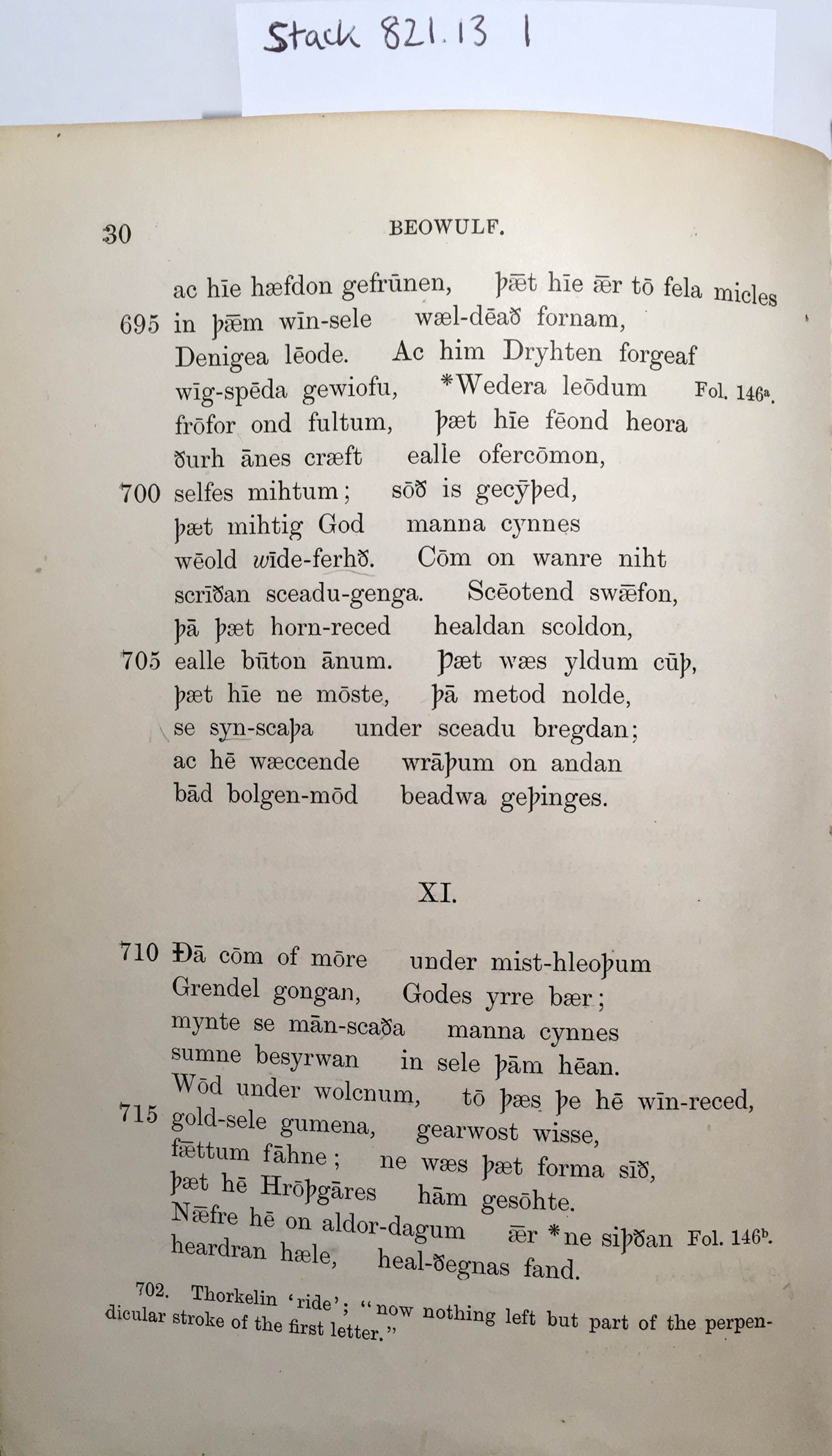
710 Ðā cōm of mōre ⁠       under mist-hleoþum
Grendel gongan , ⁠       Godes yrre bær ;
mynte se mān-scaða       ⁠ manna cynnes
sumne besyrwan ⁠       in sele þām hēan .
Wōd under wolcnum , ⁠       tō þæs þe hē wīn-reced ,
715 gold-sele gumena , ⁠       gearwost wisse ,
fǣttum fāhne ; ⁠       ne wæs þæt forma sīð ,
þæt hē Hrōþgāres       ⁠ hām gesōhte .
Nǣfre hē on aldor-dagum ⁠       ǣr ne siþðan
heardran hæle ,       ⁠ heal-ðegnas fand .
31
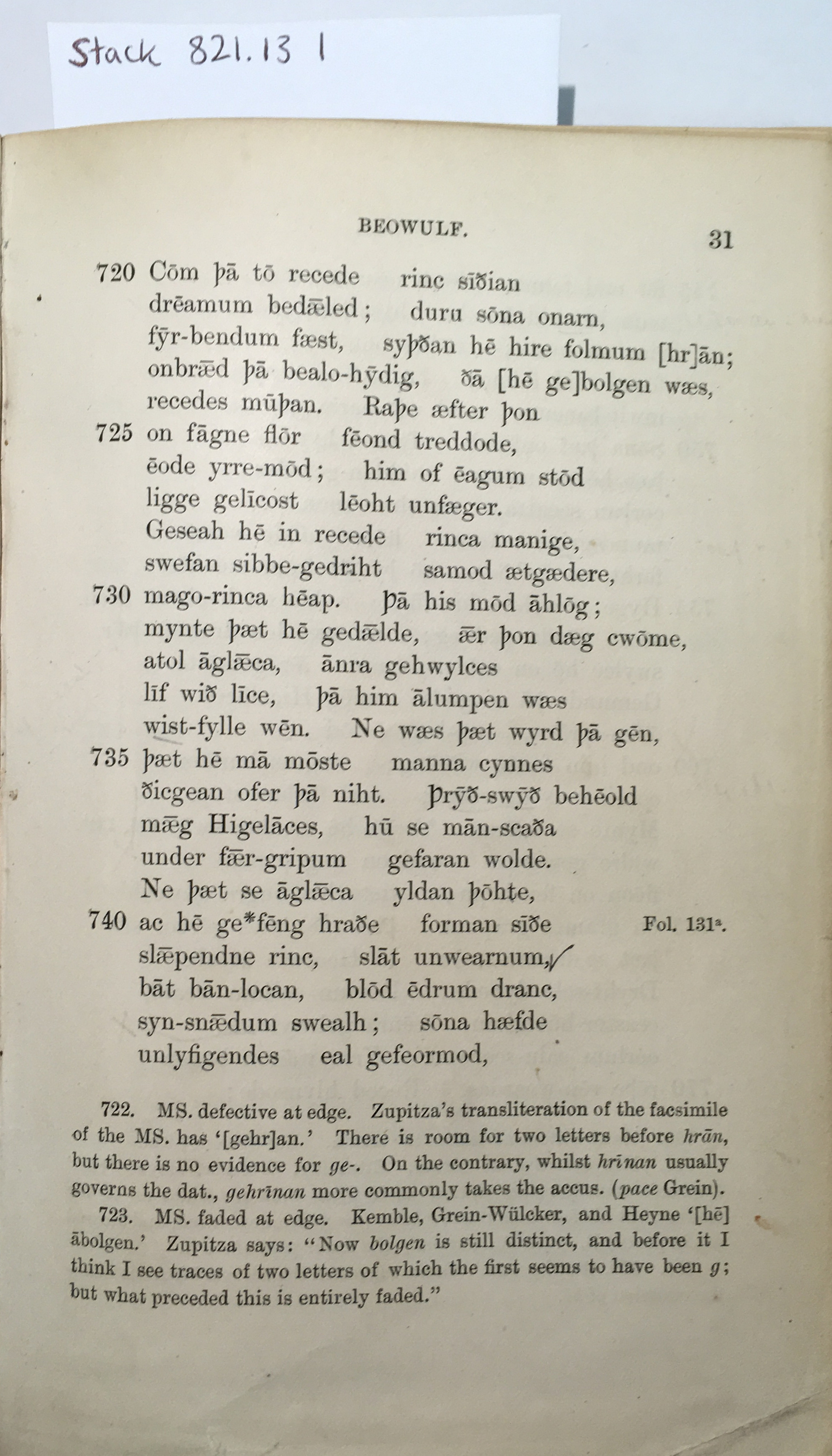
720 Cōm þā tō recede ⁠       rinc siðian
drēamum bedǣled ; ⁠       duru sōna onarn ,
fȳr-bendum fæst , ⁠       syþðan hē hire folmum [ hr ] ān ; *

722. MS. defective at edge . Zupitza's transliteration of the facsimile of the MS. has ' [ gehr ] an . ' There is room for two letters before hrān , but there is no evidence for ge - . On the contrary , whilst hrinān usually governs the dat . , gehrinān more commonly takes the accus . ( pace Grein ) .

onbrǣd þā bealo-hȳdig , ⁠       ðā [ hē ge ] bolgen wæs , *

723. MS. faded at edge . Kemble , Grein-Wülcker , and Heyne ' [ hē ] ābolgen . ' Zupitza says : " Now bolgen is still distinct , and before it I think I see traces of two letters of which the first seems to have been g ; but what preceded this is entirely faded . "

recedes mūþan . ⁠       Raþe æfter þon
725 on fāgne flōr ⁠       fēond treddode ,
ēode yrre-mōd ; ⁠       him of ēagum stōd
ligge gelīcost       ⁠ lēoht unfæger .
Geseah hē in recede       ⁠ rinca manige ,
swefan sibbe-gedriht       ⁠ samod ætgædere ,
730 mago-rinca hēap .       ⁠ Þā his mōd āhlōg ;
mynte þæt hē gedǣlde ,       ǣr þon dæg cwōme ,
atol āglǣca , ⁠       ānra gehwylces
līf wið līce , ⁠       þā him ālumpen wæs
wist-fylle wēn . ⁠       Ne wæs þæt wyrd þā gēn ,
735 þæt hē mā mōste       ⁠ manna cynnes
ðicgean ofer þā niht .       ⁠ Þrȳð-swȳð behēold
mǣg Higelāces , ⁠       hū se mān-scaða
under fǣr-gripum ⁠       gefaran wolde .
Ne þæt se āglǣca ⁠       yldan þōhte ,
740 ac hē gefēng hraðe ⁠       forman sīðe ⁠
slǣpendne rinc , ⁠       slāt unwearnum ,
bāt bān-locan , ⁠       blōd ēdrum dranc ,
syn-snǣdum swealh ;       ⁠ sōna hæfde
unlyfigendes       ⁠ eal gefeormod ,
32
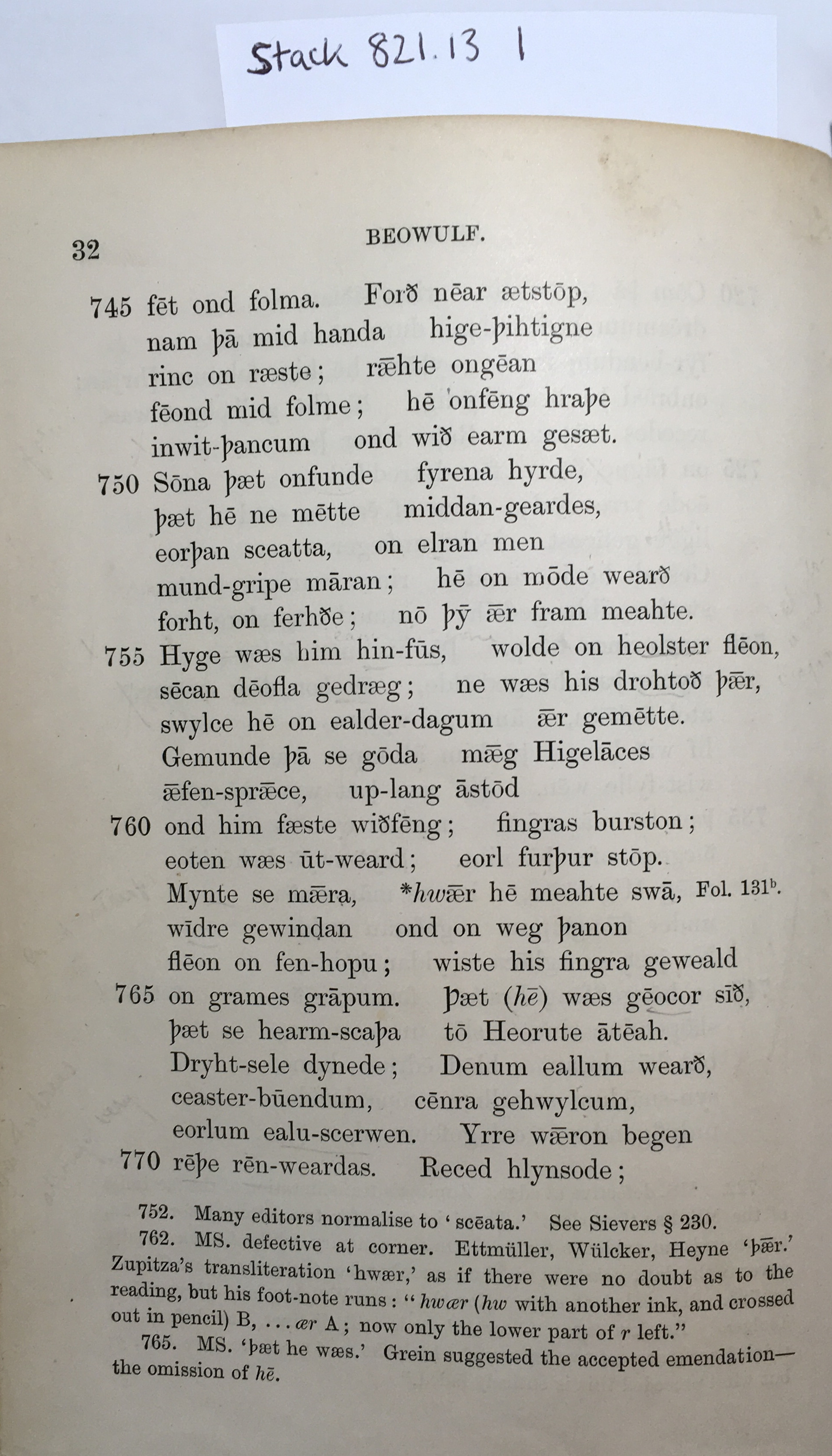
745 fēt ond folma .       ⁠ Forð nēar ætstōp ,
nam þā mid handa ⁠       hige-þihtigne
rinc on ræste ; ⁠       rǣhte ongēan
fēond mid folme ; ⁠       hē onfēng hraþe
inwit-þancum ⁠       ond wið earm gesæt .
750 Sōna þæt onfunde       ⁠ fyrena hyrde ,
þæt hē ne mētte       ⁠ middan-geardes ,
eorþan sceatta *

752. Many editors normalise to ' scēata . ' See Sievers § 230.

,       ⁠ on elran men
mund-gripe māran ;       ⁠ hē on mōde wearð
forht , on ferhðe ;       ⁠ nō þȳ ǣr fram meahte .
755 Hyge wæs him hin-fūs , ⁠       wolde on heolster flēon ,
sēcan dēofla gedræg ; ⁠       ne wæs his drohtoð þǣr ,
swylce hē on ealder-dagum       ⁠ ǣr gemētte .
Gemunde þā se gōda       ⁠ mǣg Higelāces
ǣfen-sprǣce , ⁠       ūp-lang āstōd
760 ond him fæste wiðfēng ;       ⁠ fingras burston ;
eoten wæs ūt-weard ; ⁠       eorl furþur stōp .
Mynte se mǣra , ⁠       *

762. MS. defective at corner . Ettmüller , Wülcker , Heyne ' þǣr . ' Zupitza's transliteration ' hwǣr , ' as if there were no doubt as to the reading , but his foot-note runs : " hwǣr ( hw with another ink , and crossed out in pencil ) B , ... ǣr A ; now only the lower part of r left . " Cf. l. 797.

hw ǣr hē meahte swā ,
wīdre gewindan       ⁠ ond on weg þanon
flēon on fen-hopu ; ⁠       wiste his fingra geweald
765 on grames grāpum .       ⁠ Þæt ( hē *

765. MS. ' þæt he wæs . ' Grein suggested the accepted emendation — the omission of hē .

) wæs gēocor sīð ,
þæt se hearm-scaþa       ⁠ tō Heorute ātēah .
Dryht-sele dynede ; ⁠       Denum eallum wearð ,
ceaster-būendum ,       ⁠ cēnra gehwylcum ,
eorlum ealu-scerwen . ⁠       Yrre wǣron begen
770 rēþe rēn-weardas . ⁠       Reced hlynsode ;
33
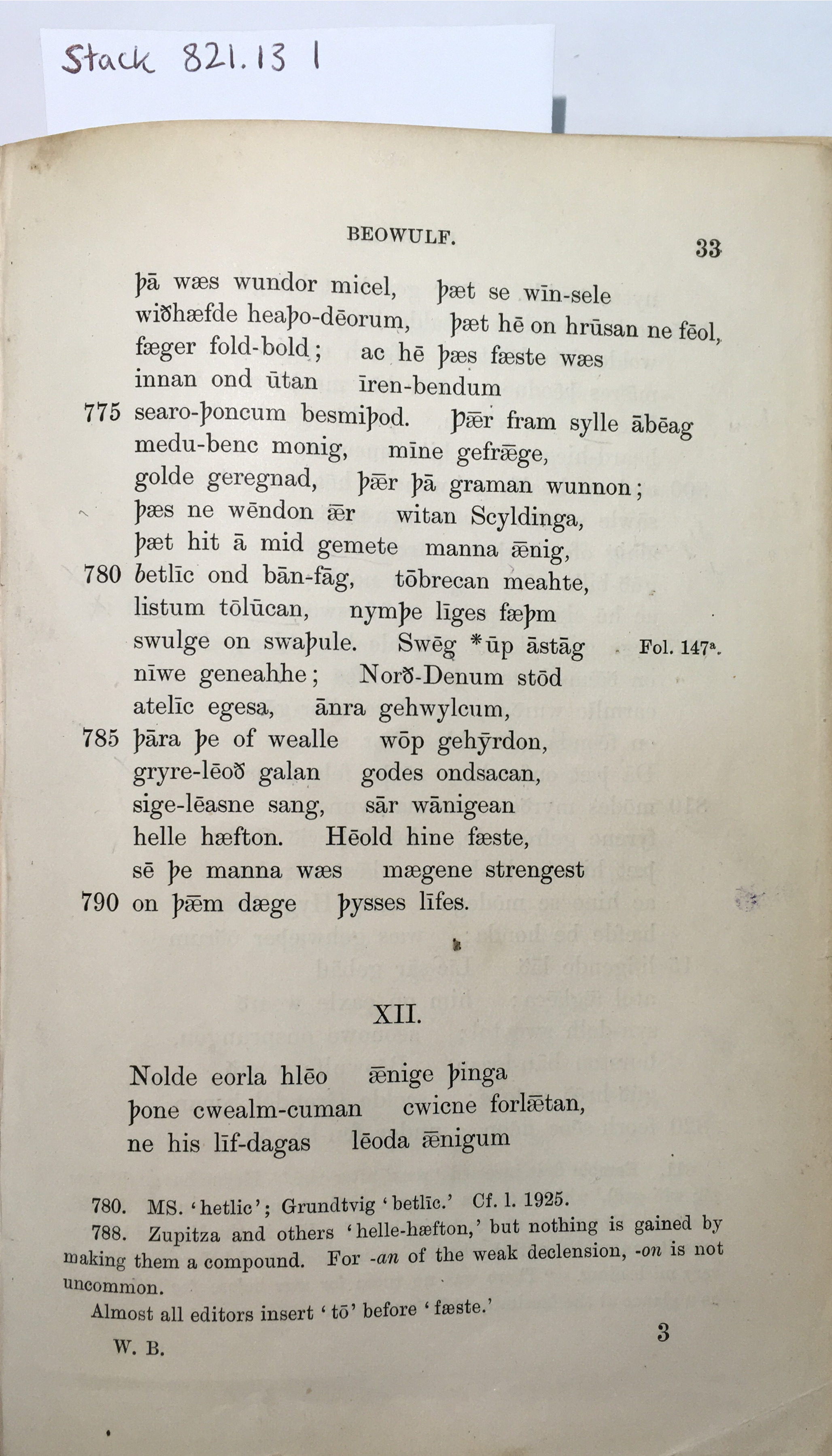
þā wæs wundor micel ,       ⁠ þæt se wīn-sele
wiðhæfde heaþo-dēorum ,       ⁠ þæt hē on hrūsan ne fēol ,
fæger fold-bold ; ⁠       ac hē þæs fæste wæs
innan ond ūtan       ⁠ īren-bendum
775 searo-þoncum besmiþod .       ⁠ Þær fram sylle ābēag
medu-benc monig , ⁠       mīne gefrǣge ,
golde geregnad , ⁠       þǣr þā graman wunnon ;
þæs ne wēndon ǣr       ⁠ witan Scyldinga ,
þæt hit ā mid gemete       ⁠ manna ǣnig ,
780 *

780. MS. ' hetlic ' ; Grundtvig ' betlīc . ' Cf. l. 1925.

b etlīc ond bān-fāg ,       ⁠ tōbrecan meahte ,
listum tōlūcan ,       ⁠ nymþe līges fæþm
swulge on swaþule . ⁠       Swēg ūp āstāg ⁠
nīwe geneahhe ; ⁠       Norð-Denum stōd
atelīc egesa , ⁠       ānra gehwylcum ,
785 þāra þe of wealle       ⁠ wōp gehȳrdon ,
gryre-lēoð galan ⁠       godes ondsacan ,
sige-lēasne sang , ⁠       sār wānigean
helle hæfton *

788. Zupitza and others ' helle-hæfton , ' but nothing is gained by making them a compound . For - an of the weak declension , - on is not uncommon .

Almost all editors insert ' tō ' before ' fæste . '

.       ⁠ Hēold hine fæste ,
sē þe manna wæs ⁠       mægene strengest
790 on þǣem dæge       ⁠ þysses līfes .
Nolde eorla hlēo ⁠       ǣnige þinga
þone cwealm-cuman       ⁠ cwicne forlǣtan ,
ne his līf-dagas ⁠       lēoda ǣnigum
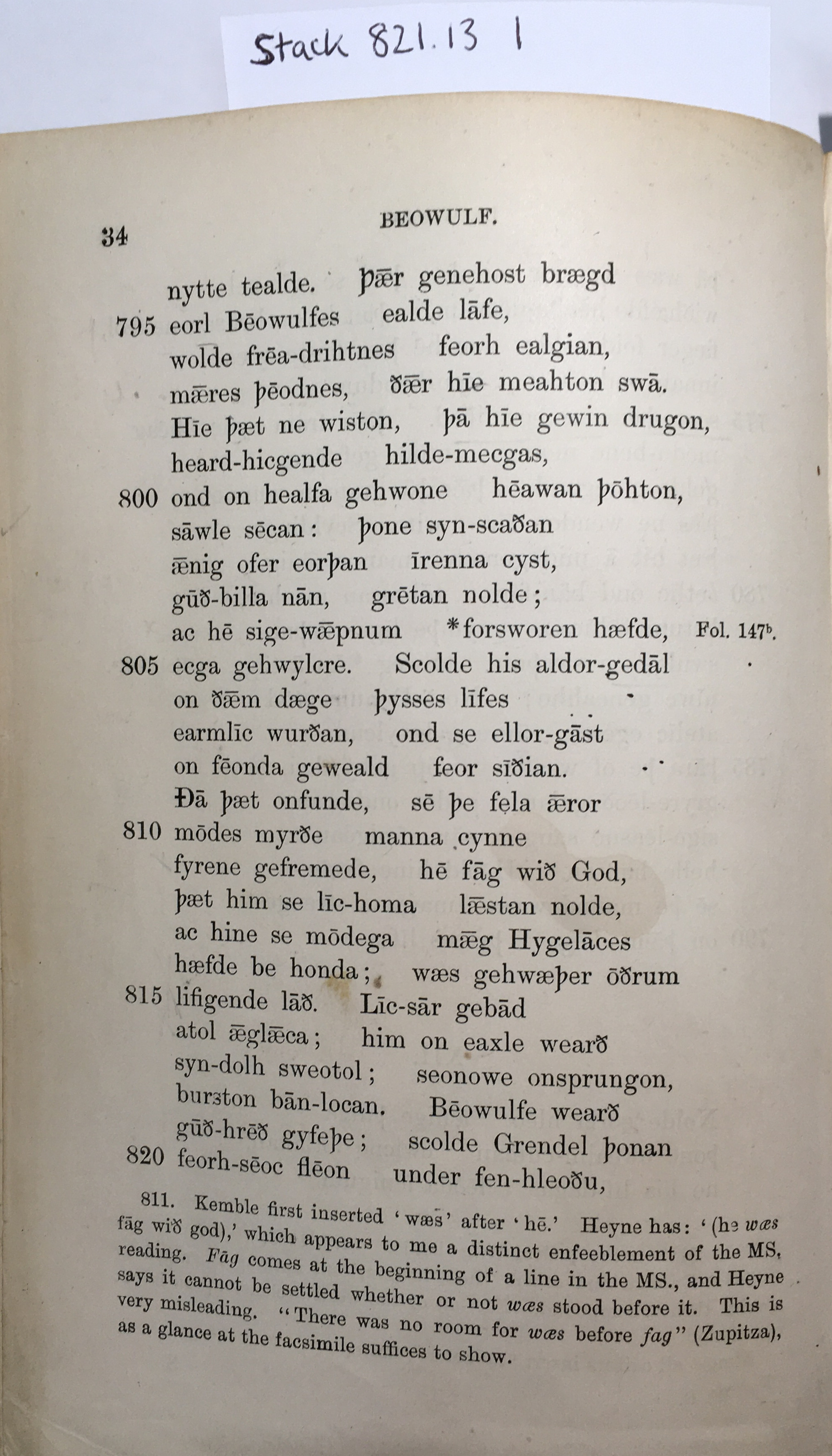
34
nytte tealde . ⁠       Þær genehost brægd
795 eorl Bēowulfes       ⁠ ealde lāfe ,
wolde frēa-drihtnes ⁠       feorh ealgian ,
mǣres þēodnes ,       ⁠ ðǣr hīe meahton swā .
Hīe þæt ne wiston ,       ⁠ þā hīe gewin drugon ,
heard-hicgende ⁠       hilde-mecgas ,
800 ond on healfa gehwone       ⁠ hēawan þōhton ,
sāwle sēcan :       ⁠ þone syn-scaðan
ǣnig ofer eorþan ⁠       īrenna cyst ,
gūð-billa nān ,       ⁠ grētan nolde ;
ac hē sige-wǣpnum ⁠       forsworen hæfde , ⁠
805 ecga gehwylcre . ⁠       Scolde his aldor-gedāl
on ðǣm dæge ⁠       þysses līfes
earmlīc wurðan , ⁠       ond se ellor-gāst
on fēonda geweald       ⁠ feor sīðian .
Ðā þæt onfunde , ⁠       sē þe fela ǣror
810 mōdes myrðe       ⁠ manna cynne
fyrene gefremede , ⁠       hē *

811. Kemble first inserted ' wæs ' after ' hē . ' Heyne has : ' ( he wæs fāg wið god ) , ' which appears to me a distinct enfeeblement of the MS. reading . Fāg comes at the beginning of a line in the MS. , and Heyne says it cannot be settled whether of not wæs stood before it . This is very misleading . " There was no room for wæs before fag " ( Zupitza ) , as a glance at the facsimile suffices to show .

fāg wið God ,
þæt him se līc-homa       ⁠ lǣstan nolde ,
ac hine se mōdega       ⁠ mǣg Hygelāces
hæfde be honda ;       ⁠ wæs gehwæþer ōðrum
815 lifigende lāð . ⁠       Līc-sār gebād
atol ǣglǣca ; ⁠       him on eaxle wearð
syn-dolh sweotol ; ⁠       seonowe onsprungon ,
burston bān-locan .       ⁠ Bēowulfe wearð
gūð-hrēð gyfeþe ;       ⁠ scolde Grendel þonan
820 feorh-sēoc flēon       ⁠ under fen-hleoðu ,
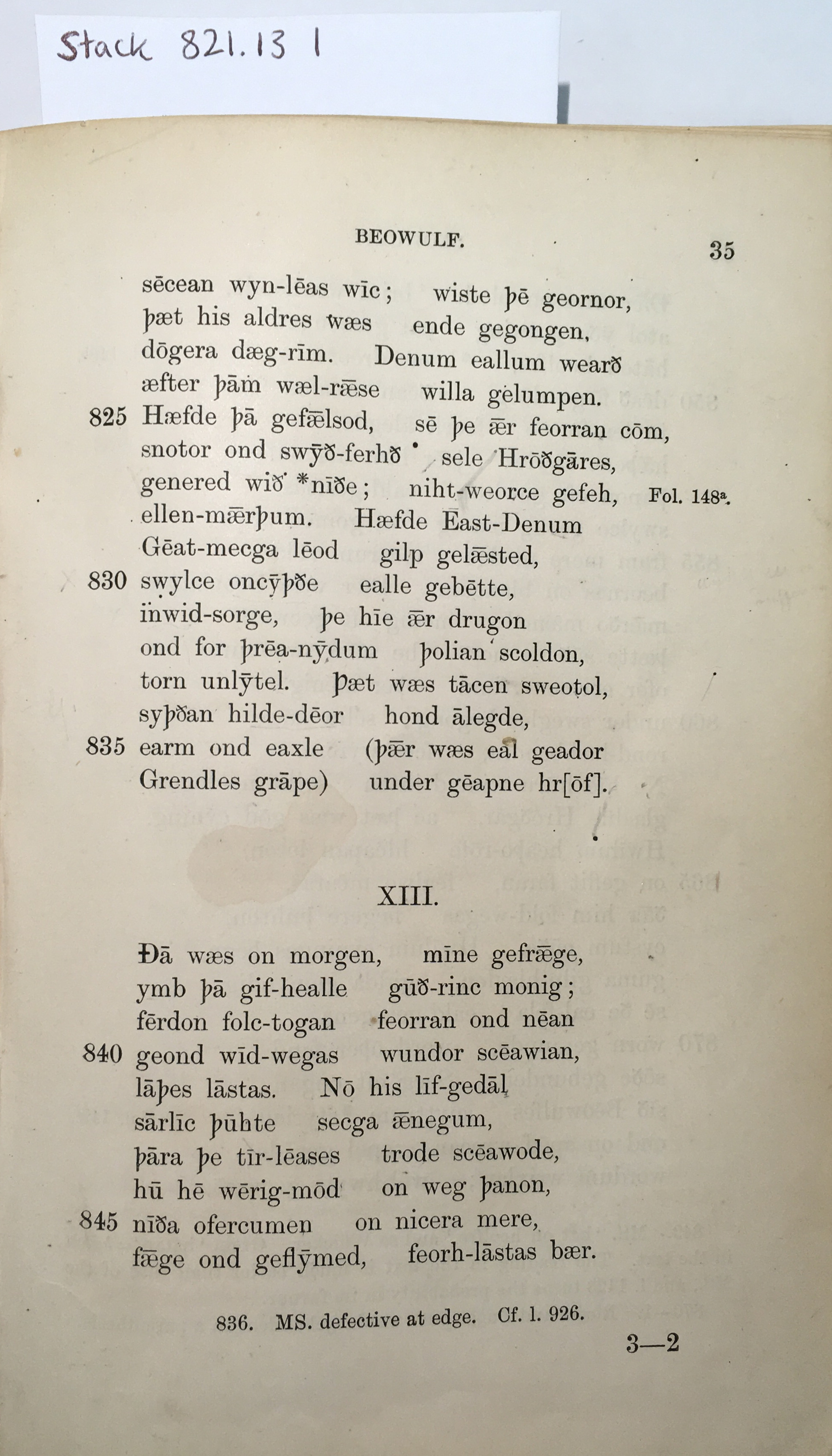
35
sēcean wyn-lēas wīc ; ⁠       wiste þē geornor ,
þæt his aldres wæs       ⁠ ende gegongen ,
dōgera dæg-rīm . ⁠       Denum eallum wearð
æfter þām wæl-rǣse ⁠       willa gelumpen .
825 Hæfde þā gefǣlsod ,       ⁠ sē þe ǣr feorran cōm ,
snotor ond swȳð-ferhð       ⁠ sele Hrōðgāres ,
genered wið nīðe ;       ⁠ niht-weorce gefeh ,
ellen-mǣrþum . ⁠       Hæfde East-Denum
Gēat-mecga lēod ⁠       gilp gelǣsted ,
830 swylce oncȳþðe       ⁠ ealle gebētte ,
inwid-sorge , ⁠       þe hīe ǣr drugon
ond for þrēa-nȳdum       ⁠ þolian scoldon ,
torn unlȳtel .       ⁠ Þæt wæs tācen sweotol ,
syþðan hilde-dēor ⁠       hond ālegde ,
835 earm ond eaxle       ⁠ ( þǣr wæs eal geador
Grendles grāpe ) ⁠       under gēapne hr [ ōf ] *

836. MS. defective at edge . Cf. l. 926

.
Ðā wæs on morgen , ⁠       mīne gefrǣge ,
ymb þā gif-healle ⁠       gūð-rinc monig ;
fērdon folc-togan       ⁠ feorran ond nēan
840 geond wīd-wegas ⁠       wundor scēawian ,
lāþes lāstas . ⁠       Nō his līf-gedāl
sārlīc þūhte ⁠       secga ǣnegum ,
þāra þe tīr-lēases       ⁠ trode scēawode ,
hū hē wērig-mōd ⁠       on weg þanon ,
845 nīða ofercumen       ⁠ on nicera mere ,
fǣge ond geflȳmed ,       ⁠ feorh-lāstas bær .
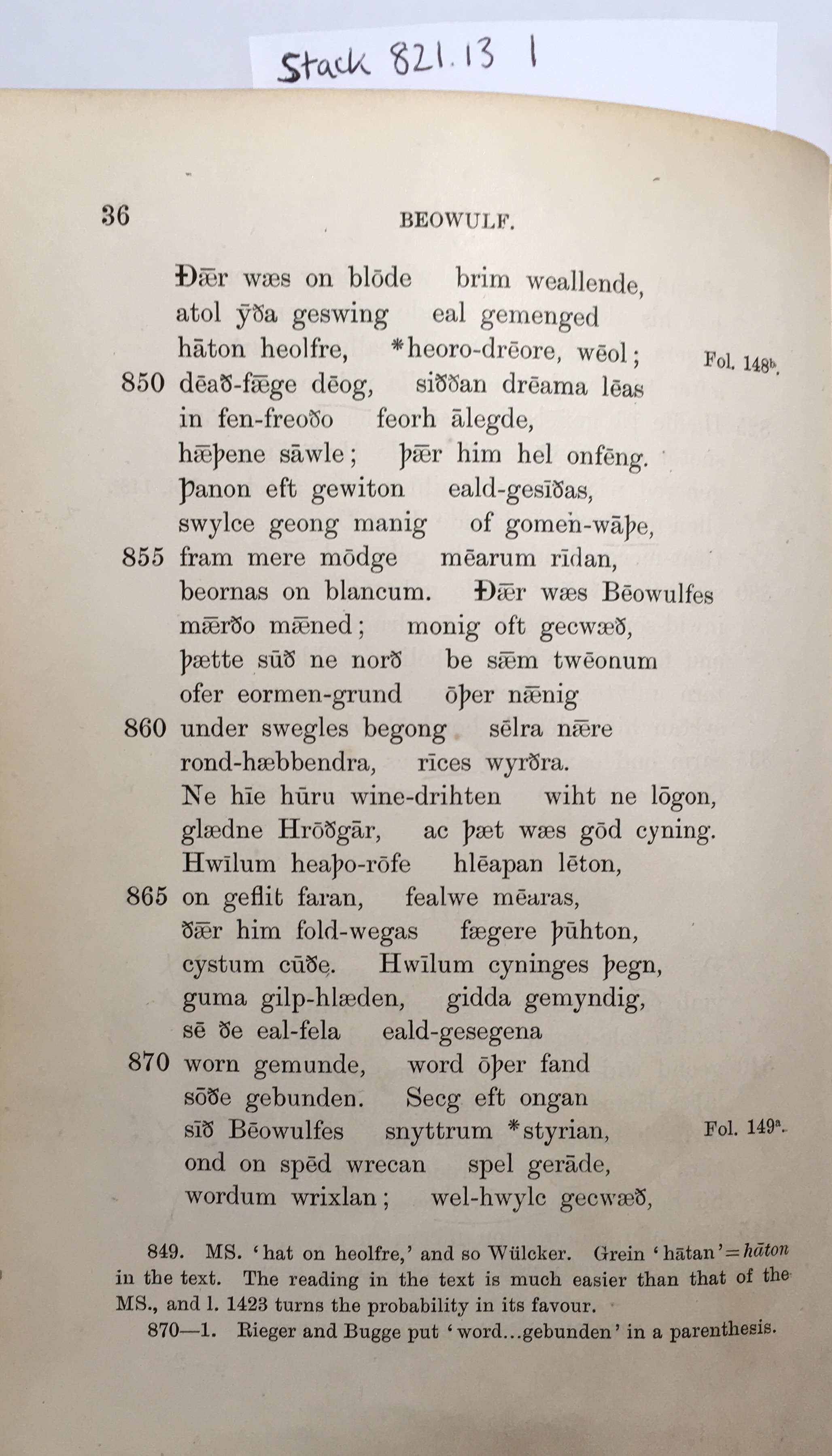
36
Ðǣr wæs on blōde       ⁠ brim weallende ,
atol ȳða geswing       ⁠ eal gemenged
hāton heolfre ,       *

849. MS. ' hat on heolfre , ' and so Wülcker . Grein ' hātan ' = hāton in the text . The reading in the text is much easier than that of the MS. , and l. 1423 turns the probability in its favour .

⁠ heoro-drēore , wēol ;
850 dēað-fǣge dēog ,       ⁠ siððan drēama lēas
in fen-freoðo       ⁠ feorh ālegde ,
hǣþene sāwle ; ⁠       þǣr him hel onfēng .
Þanon eft gewiton ⁠       eald-gesīðas ,
swylce geong manig       ⁠ of gomen-wāþe ,
855 fram mere mōdge ⁠       mēarum rīdan ,
beornas on blancum .       ⁠ Ðǣr wæs Bēowulfes
mǣrðo mǣned ; ⁠       monig oft gecwæð ,
þætte sūð ne norð       ⁠ be sǣm twēonum
ofer eormen-grund ⁠       ōþer nǣnig
860 under swegles begong ⁠       sēlra nǣre
rond-hæbbendra , ⁠       rīces wyrðra .
Ne hīe hūru wine-drihten       ⁠ wiht ne lōgon ,
glædne Hrōðgār , ⁠       ac þǣt wæs gōd cyning .
Hwīlum heaþo-rōfe       ⁠ hlēapan lēton ,
865 on geflit faran , ⁠       fealwe mēaras ,
ðǣr him fold-wegas ⁠       fægere þūhton ,
cystum cūðe . ⁠       Hwīlum cyninges þegn ,
guma gilp-hlæden ,       ⁠ gidda gemyndig ,
sē ðe eal-fela ⁠       eald-gesegena
870 worn gemunde , ⁠       *

870-1 . Rieger and Bugge put ' word ... gebunden ' in a parenthesis

⁠ word ōþer fand
sōðe gebunden .       Secg eft ongan
sīð Bēowulfes ⁠       snyttrum styrian , ⁠
ond on spēd wrecan       ⁠ spel gerāde ,
wordum wrixlan ; ⁠       wel-hwylc gecwæð ,
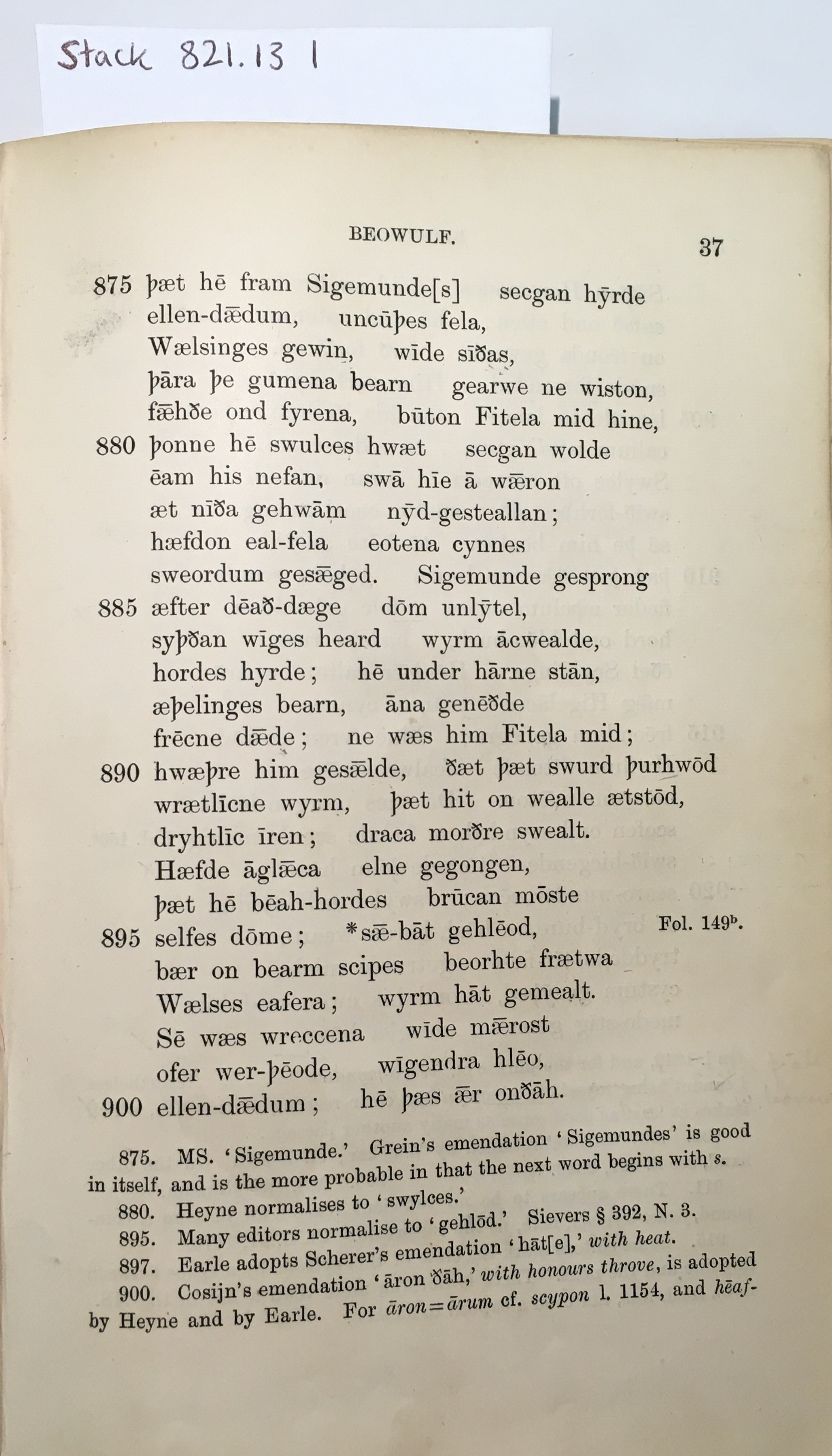
37
875 þæt hē fram Sigemunde [ s ] *

875. MS. ' Sigemunde . ' Grein's emendation ' Sigemundes ' is good in itself , and is more probably in that the next word begins with s .

⁠       ⁠ secgan hȳrde
ellen-dǣdum , ⁠       uncūþes fela ,
Wælsinges gewin ,       ⁠ wīde sīðas ,
þāra þe gumena bearn       ⁠ gearwe ne wiston ,
fǣhðe ond fyrena , ⁠       būton Fitela mid hine ,
880 þonne hē swulces *

880. Heyne normalises to ' swylces . '

hwæt ⁠       secgan wolde
ēam his nefan , ⁠       swā hie ā wǣron
æt nīða gehwām ⁠       nȳd-gesteallan ;
hæfdon eal-fela       ⁠ eotena cynnes
sweordum gesǣged .       ⁠ Sigemunde gesprong
885 æfter dēað-dæge ⁠       dōm unlȳtel ,
syþðan wīges heard ⁠       wyrm ācwealde ,
hordes hyrde ; ⁠       hē under hārne stān ,
æþelinges bearn , ⁠       āna genēðde
frēcne dǣde ; ⁠       ne wæs him Fitela mid ;
890 hwæþre him gesǣlde , ⁠       ðæt þæt swurd þurhwōd
wrætlīcne wyrm , ⁠       þæt hit on wealle ætstōd ,
dryhtlīc īren ; ⁠       draca morðre swealt .
Hæfde āglǣca ⁠       elne gegongen ,
þæt hē bēah-hordes ⁠       brūcan mōste
895 selfes dōme ; ⁠       *

895. Many editors normalise to ' gehlōd . ' Sievers § 392 , N. 3.

sǣ-bāt gehlēod ,
bær on bearm scipes ⁠       beorhte frætwa
Wælses eafera ; ⁠       wyrm hāt *

897. Earle adopts Scherer's emendation ' hāt [ e ] , ' with heat .

gemealt .
Sē wæs wreccena       ⁠ wīde mǣrost
ofer wer-þēode , ⁠       wīgendra hlēo ,
900 ellen-dǣdum ;       ⁠ hē þæs ǣr onðāh . *

900. Cosijn's emendation ' āron ðāh , ' with honours throve , is adopted by Heyne and by Earle . For āron = ārun cf. scypon l. 1154 , and hēafdon l. 1242 , and for the phrase cf. weorð-myndum þāh l. 8. Nevertheless I cannot bring myself to abandon the clear reading of the MS. , which makes at least as good sense as many another passage .

38
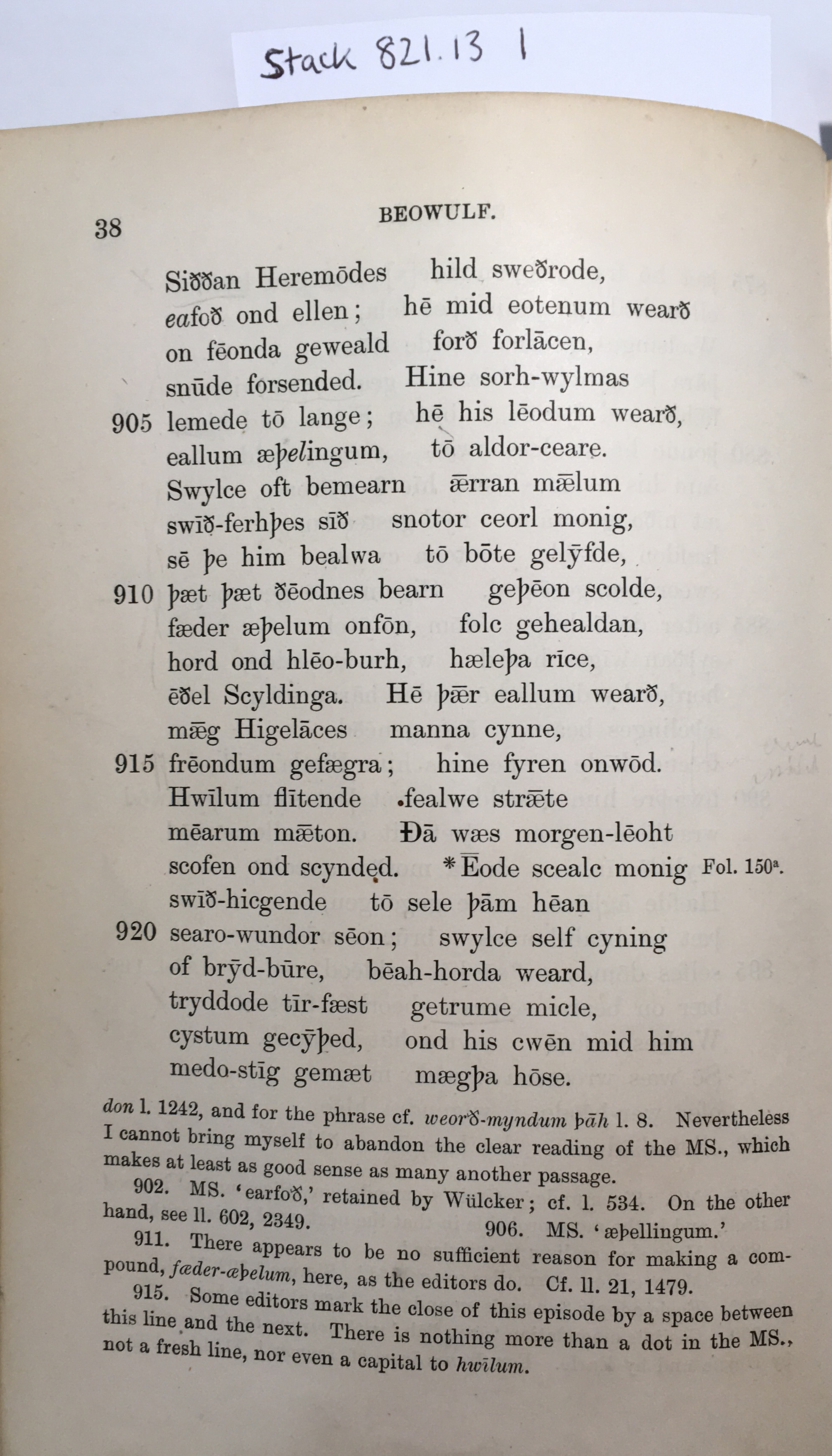
Siððan Heremōdes ⁠       hild sweðrode ,
*

902. MS. ' earfoð , ' retained by Wülcker ; cf. l. 534. On the other hand , see ll . 602 , 2349.

ea foð ond ellen , ⁠       hē mid eotenum wearð
on fēonda geweald ⁠       forð forlācen ,
snūde forsended . ⁠       Hine sorh-wylmas
905 lemede tō lange ;       ⁠ hē his lēodum wearð ,
eallum æþ el ingum *

906. ' æþellingum . '

,       ⁠ to aldor-ceare .
Swylce oft bemearn       ⁠ ǣrran mǣlum
swið-ferhþes sīð ⁠       snotor ceorl monig ,
sē þe him bealwa       ⁠ tō bōte gelȳfde ,
910 þæt þæt ðēodnes bearn       ⁠ geþēon scolde ,
fæder æþelum *

911. There appears to be no sufficient reason for making a compound , fæder-æþelum , here , as the editors do . Cf. ll . 21 , 1479.

onfōn , ⁠       folc gehealdan ,
hord ond hlēo-burh , ⁠       hæleþa rīce ,
ēðel Scyldinga .       ⁠ Hē þǣr eallum wearð ,
mǣg Higelāces       ⁠ manna cynne ,
915 frēondum gefægra ;       ⁠ hine fyren onwōd . *

915. Some editors mark the close of this episode by a space between this line and the next . There is nothing more than a dot in the MS. , not a fresh line , nor even a capital to hwīlum .

Hwīlum flītende ⁠       fealwe strǣte
mēarum mǣton .       ⁠ Ðā wæs morgen-lēoht
scofen ond scynded . ⁠       Eode scealc monig
switð-hicgende       ⁠ tō sele þām hēan
920 searo-wundor sēon ;       ⁠ swylce self cyning
of brȳd-būre , ⁠       bēah-horda weard ,
tryddode tīr-fæst ⁠       getrume micle ,
cystum gecȳþed ,       ⁠ ond his cwēn mid him
medo-stīg gemæt ⁠       mægþa hōse .
39
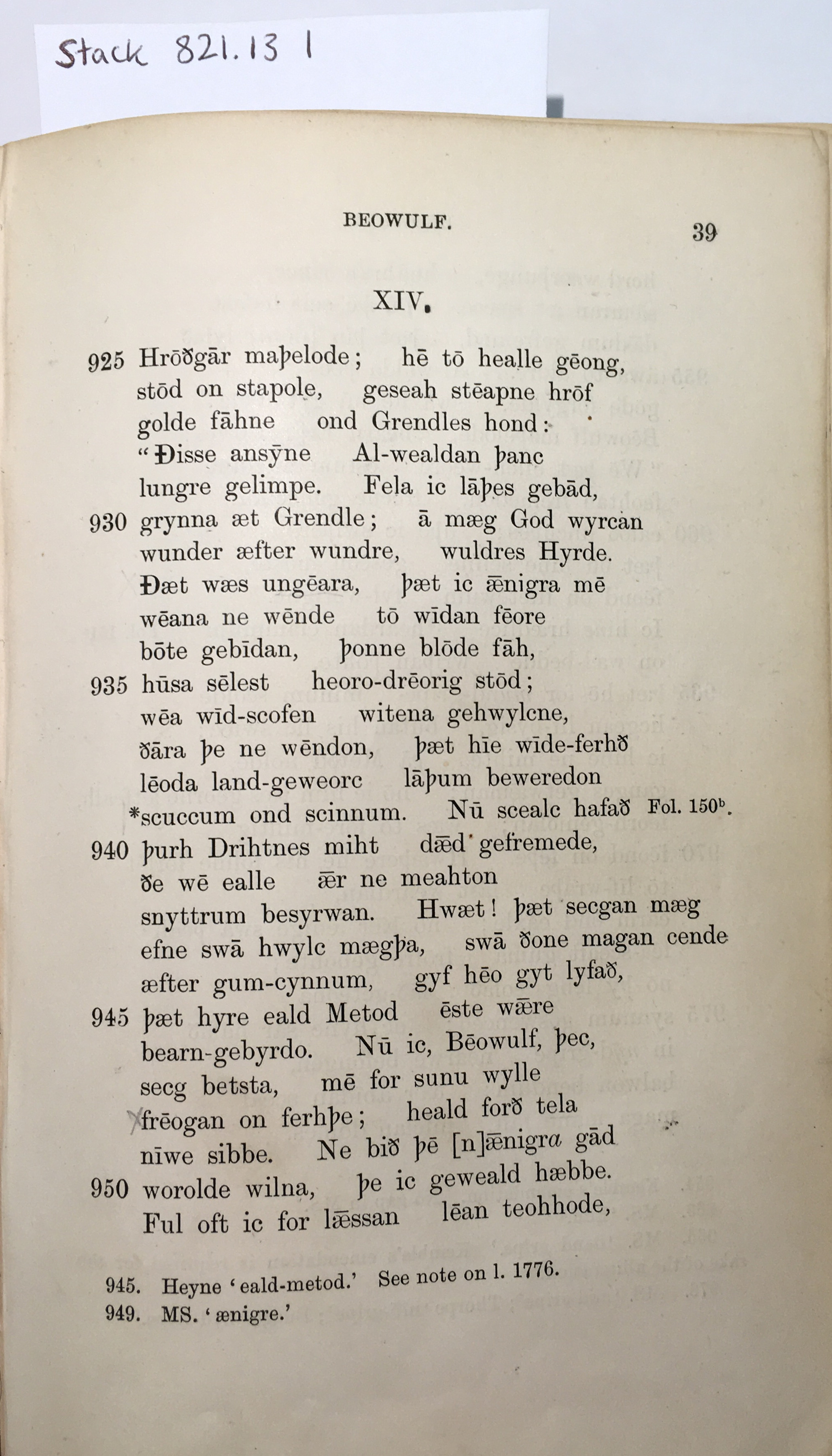
925 Hrōðgār maþelode ; ⁠       hē tō healle gēong ,
stōd on stapole , ⁠       geseah stēapne hrōf
golde fāhne ⁠       ond Grendles hond :
“ Ðisse ansȳne ⁠       Al-wealdan þanc
lungre gelimpe .       ⁠ Fela ic lāþes gebād ,
930 grynna æt Grendle ;       ⁠ ā mæg God wyrcan
wunder æfter wundre ,       ⁠ wuldres Hyrde .
Ðæt wæs ungēara , ⁠       þæt ic ǣnigra mē
wēana ne wēnde       ⁠ tō wīdan fēore
bōte gebīdan , ⁠       þonne blōde fāh ,
935 hūsa sēlest       ⁠ heoro-drēorig stōd ;
wēa wīd-scofen ⁠       witena gehwylcne ,
ðāra þe ne wēndon ,       ⁠ þæt hīe wīde-ferhð
lēoda land-geweorc ⁠       lāþum beweredon
scuccum ond scinnum .       ⁠ Nū scealc hafað ⁠
940 þurh Drihtnes miht ⁠       dǣd gefremede ,
ðe wē ealle       ⁠ ǣr ne meahton
snyttrum besyrwan .       ⁠ Hwæt ! þæt secgan mæg
efne swā hwylc mægþa , ⁠       swā ðone magan cende
æfter gum-cynnum ,       ⁠ gyf hēo gyt lyfað ,
945 þæt hyre eald Metod *

945. Heyne ' eald-metod . ' See note on l. 1776.

      ⁠ ēste wǣre
bearn-gebyrdo . ⁠       Nū ic , Bēowulf , þec ,
secg betsta ,       ⁠ mē for sunu wylle
frēogan on ferhþe ; ⁠       heald forð tela
nīwe sibbe . ⁠       Ne bið þē [ n ] ǣnigr a *

949. MS. ' ǣnigre . '

gād
950 worolde wilna ,       ⁠ þe ic geweald hæbbe .
Ful oft ic for lǣssan ⁠       lēan teohhode ,
40
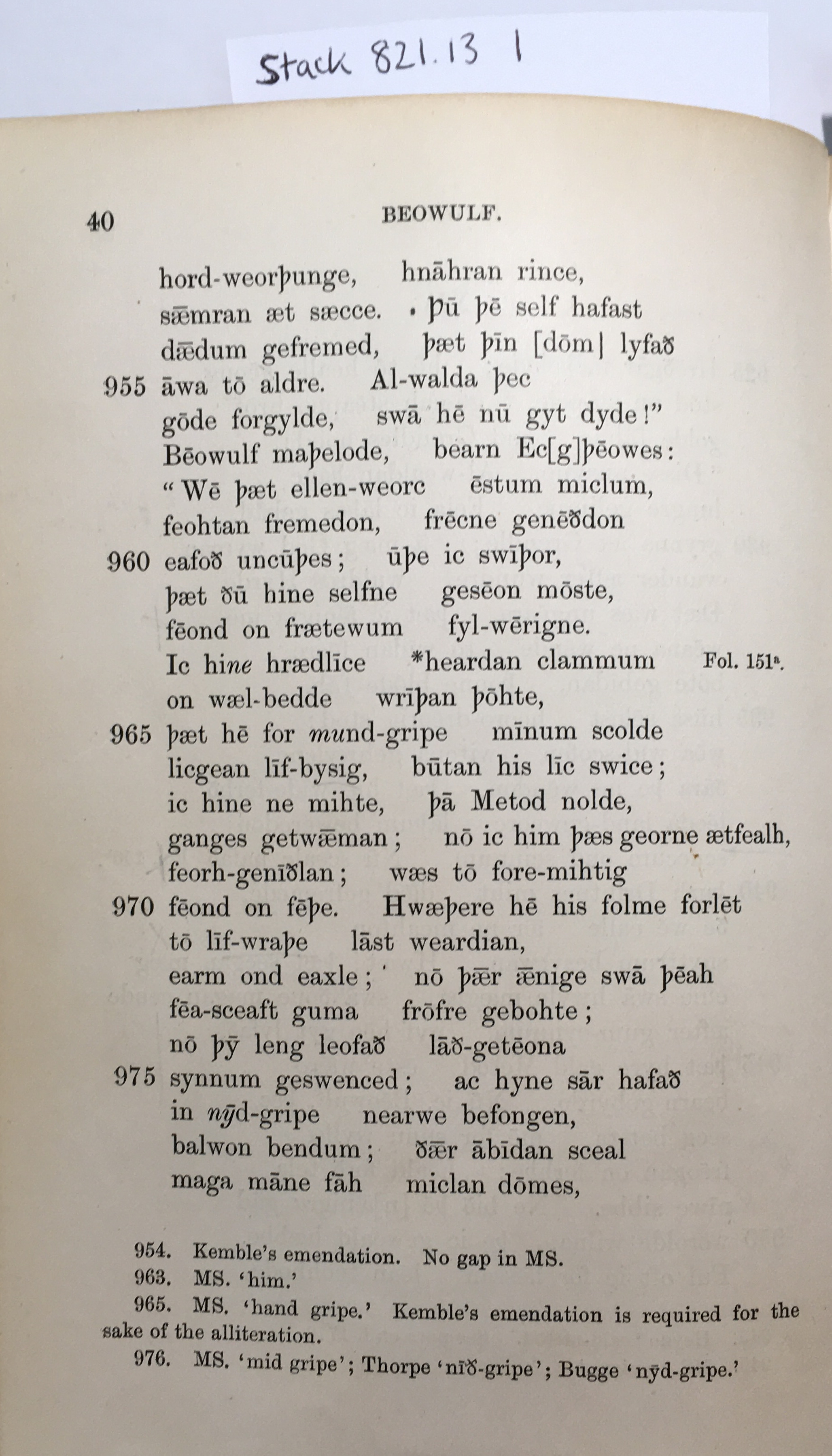
hord-weorþunge ,       ⁠ hnāhran rince ,
sǣmran æt sæcce . ⁠       Þū þē self hafast
dǣdum gefremed ,       þæt þīn [ dōm ] *

954. Kemble's emendation . No gap in MS.

lyfað
955 āwa tō aldre .       ⁠ Al-walda þec
gōde forgylde , ⁠       swā hē nū gyt dyde ! ”
Bēowulf maþelode , ⁠       bearn Ec [ g ] þēowes :
“ Wē þæt ellen-weorc ⁠       ēstum miclum ,
feohtan fremedon , ⁠       frēcne genēðdon
960 eafoð uncūþes ; ⁠       ūþe ic swīþor ,
þæt ðū hine selfne       ⁠ gesēon mōste ,
fēond on frætewum ⁠       fyl-wērigne .
Ic hi ne *

963. MS. ' him . '

hrædlīce ⁠       heardan clammum
on wæl-bedde ⁠       wrīþan þōhte ,
965 þæt hē for mu nd-gripe *

965. MS. ' hand gripe . ' Kemble's emendation is required for the sake of the alliteration .

      ⁠ mīnum scolde
licgean līf-bysig ,       ⁠ būtan his līc swice ;
ic hine ne mihte ,       ⁠ þā Metod nolde ,
ganges getwǣman ;       ⁠ nō ic him þæs georne ætfealh ,
feorh-geniðlan ;       ⁠ wæs tō fore-mihtig
970 fēond on fēþe .       ⁠ Hwæþere hē his folme forlēt
tō līf-wraþe       ⁠ lāst weardian ,
earm ond eaxle ; ⁠       nō þǣr ǣnige swā þēah
fēa-sceaft guma ⁠       frōfre gebohte ;
nō þȳ leng leofað ⁠       lāð-getēona
975 synnum geswenced ;       ac hyne sār hafað
in nȳ d-gripe *

976. MS. ' mid gripe ' ; Thorpe ' nið-gripe ' ; Bugge ' nȳd-gripe . '

      nearwe befongen ,
balwon bendum ; ⁠       ðǣr ābīdan sceal
maga māne fāh       ⁠ miclan dōmes ,
41
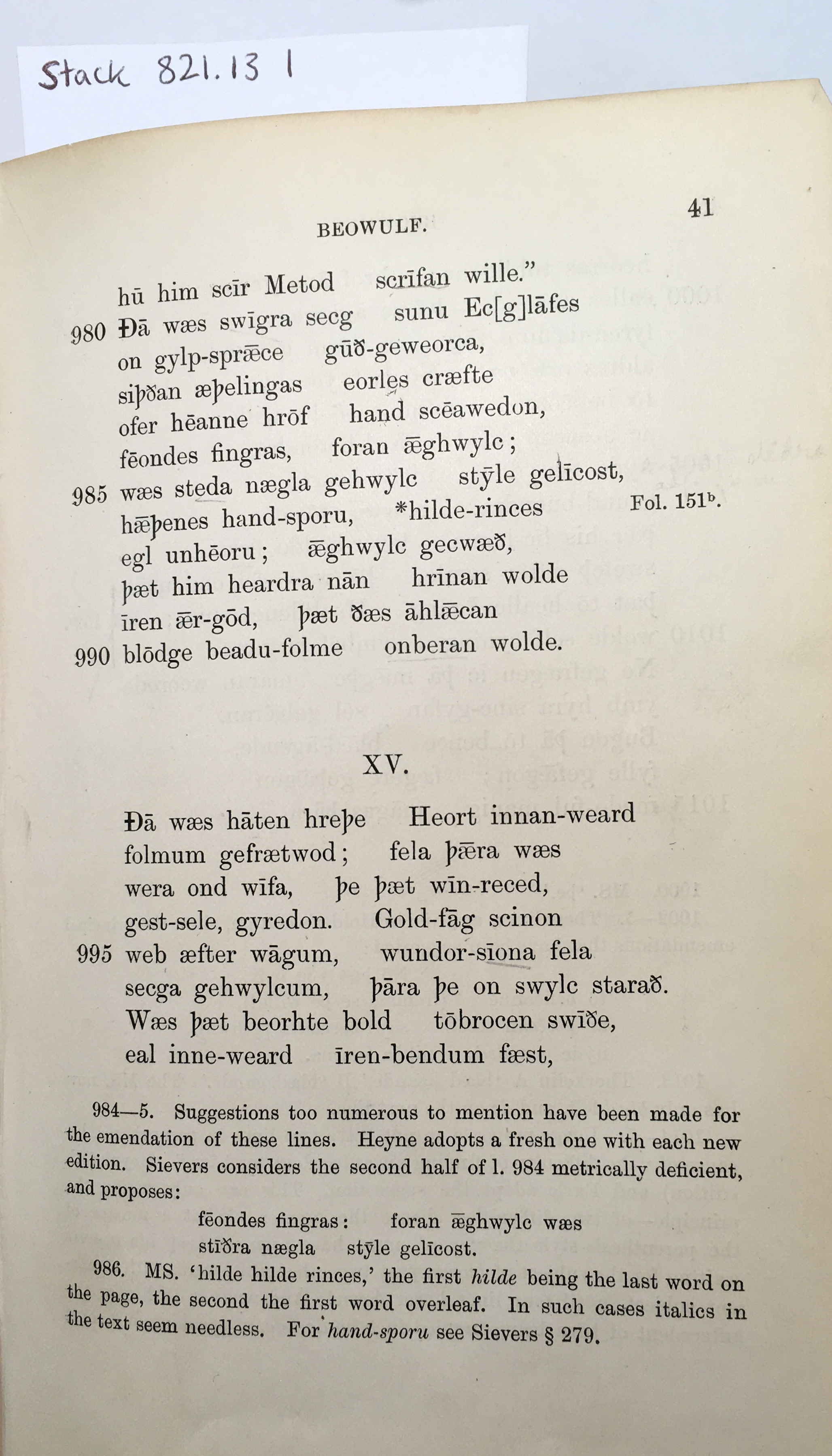
hū him scīr Metod       ⁠ scrīfan wille . ”
980 Ðā wæs swīgra secg ⁠       sunu Ec [ g ] lāfes
on gylp-sprǣce       ⁠ gūð-geweorca ,
siþðan æþelingas ⁠       eorles cræfte
ofer hēanne hrōf ⁠       hand scēawedon ,
fēondes fingras ,       ⁠ foran ǣghwylc ;
985 wæs steda nægla gehwylc       ⁠ stȳle gelīcost , *

984-5 . Suggestions too numerous to mention have been made for the emendation of these lines . Heyne adopts a fresh one with each new edition . Sievers considers the second half of l. 984 metrically deficient , and proposes :

fēondes fingras , ⁠ foran ǣghwylc wæs

stiðra nægla stȳle gelīcost .

hǣþenes hand-sporu , ⁠       *

986. MS. ' hilde hilde rinces , ' the first hilde being the last word on the page , the second the first word overleaf . In such cases italics in the text seem needless . For hand-sporu see Sievers § 279.

hilde-rinces
egl unhēoru ;       ⁠ ǣghwylc gecwæð ,
þæt him heardra nān ⁠       hrīnan wolde
īren ǣr-gōd ,       þæt ðæs āhlǣcan
990 blōdge beadu-folme       ⁠ onberan wolde .
Ðā wæs hāten hreþe ⁠       Heort innan-weard
folmum gefrætwod ; ⁠       fela þǣra wæs
wera ond wīfa , ⁠       þe þæt wīn-reced ,
gest-sele , gyredon .       ⁠ Gold-fāg scinon
995 web æfter wāgum ,       ⁠ wundor-sīona fela
secga gehwylcum , ⁠       þāra þe on swylc starað .
Wæs þæt beorhte bold ⁠       tōbrocen swīðe ,
eal inne-weard       ⁠ īren-bendum fæst ,
42
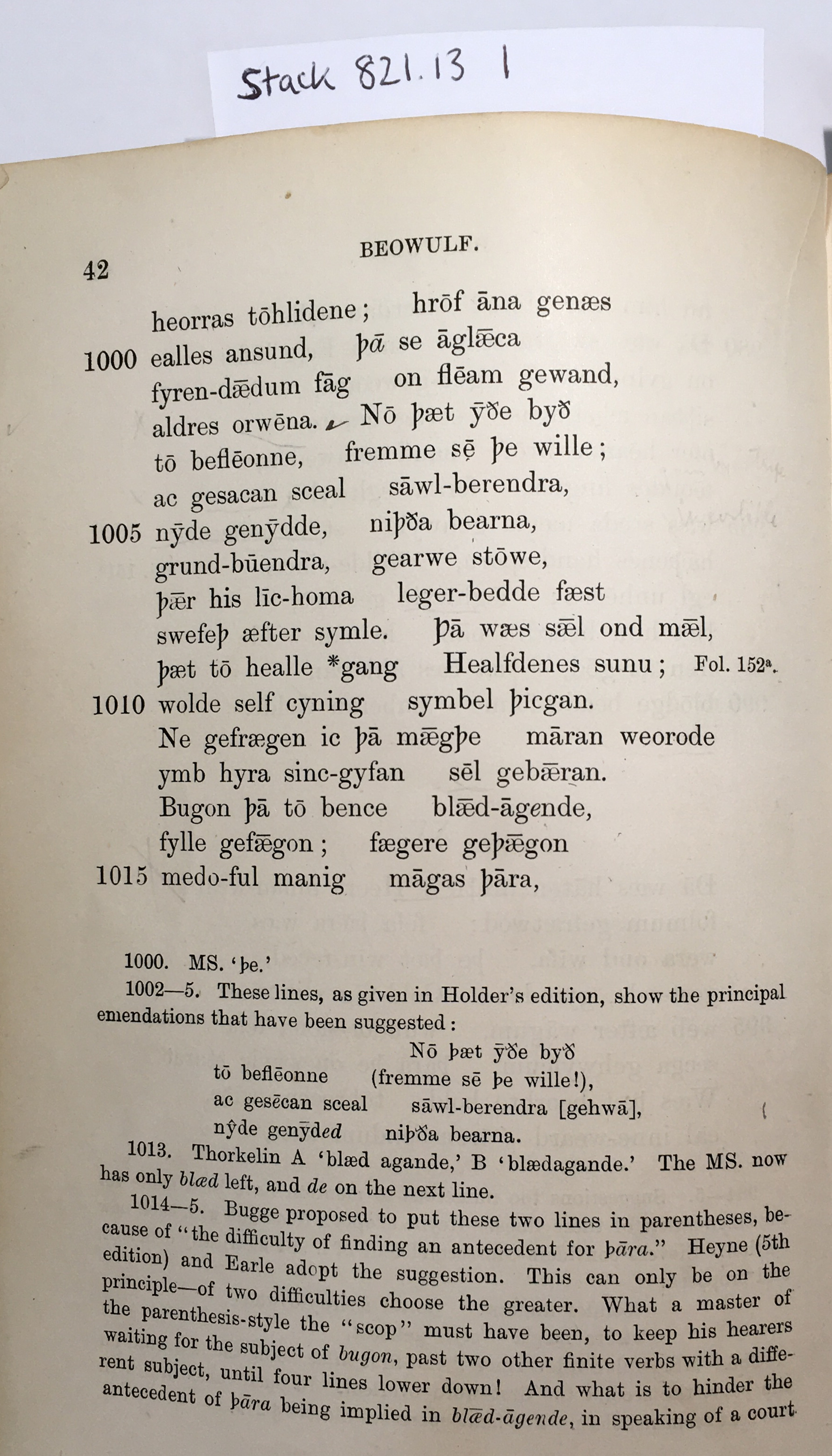
heorras tōhlidene ; ⁠       hrōf āna genæs
1000 ealles ansund , ⁠       þ ā *

1000. MS. ' þe . '

se āglǣca
fyren-dǣdum fāg       ⁠ on flēam gewand ,
aldres orwēna . ⁠       *

1002-5 . These lines , as given in Holder's edition , show the principal emendations that have been suggested :

Nō þæt ȳðe byð

tō beflēonne ( fremme sē þe wille ! ) ,

ac ges ē can sceal ⁠ sāwl-berendra [ gehwā ] ,

nȳde genȳd ed ⁠ niþða bearna .

Nō þæt ȳðe byð
tō beflēonne , ⁠       fremme sē þe wille ;
ac gesacan sceal ⁠       sāwl-berendra ,
1005 nȳde genȳdde ,       ⁠ niþða bearna ,
grund-būendra ,       ⁠ gearwe stōwe ,
þǣr his līc-homa ⁠       leger-bedde fæst
swefeþ æfter symle .       ⁠ Þā wæs sǣl ond mǣl ,
þæt tō healle gang       ⁠ Healfdenes sunu ; ⁠
1010 wolde self cyning       ⁠ symbel þicgan .
Ne gefrægen ic þā mǣgþe       ⁠ māran weorode
ymb hyra sinc-gyfan       ⁠ sēl gebǣran .
Bugon þā tō bence       ⁠ blǣd-āg e nde , *

1013. Thorkelin A ' blæd agande , ' B ' blædagande . ' The MS. now has only blæd left , and de on the next line .

fylle gefǣgon ; ⁠       fægere geþǣgon
1015 medo-ful manig ⁠       māgas þāra , *

1014-5 . Bugge proposed to put these two lines in parentheses , because of " the difficulty of finding an antecedent for þāra . " Heyne ( 5th edition ) and Earle adopt the suggestion . This can only be on the principle — of two difficulties choose the greater . What a master of parenthesis-style the " scop " must have been , to keep his hearers waiting for the subject of bugon , past two other finite verbs with a different subject , until four lines lower down ! And what is to hinder the antecedent of þāra being implied in ⁠ blǣd-āgende , in speaking of a court where everyone was doubtless related to everyone else , as in a Scotch clan ?

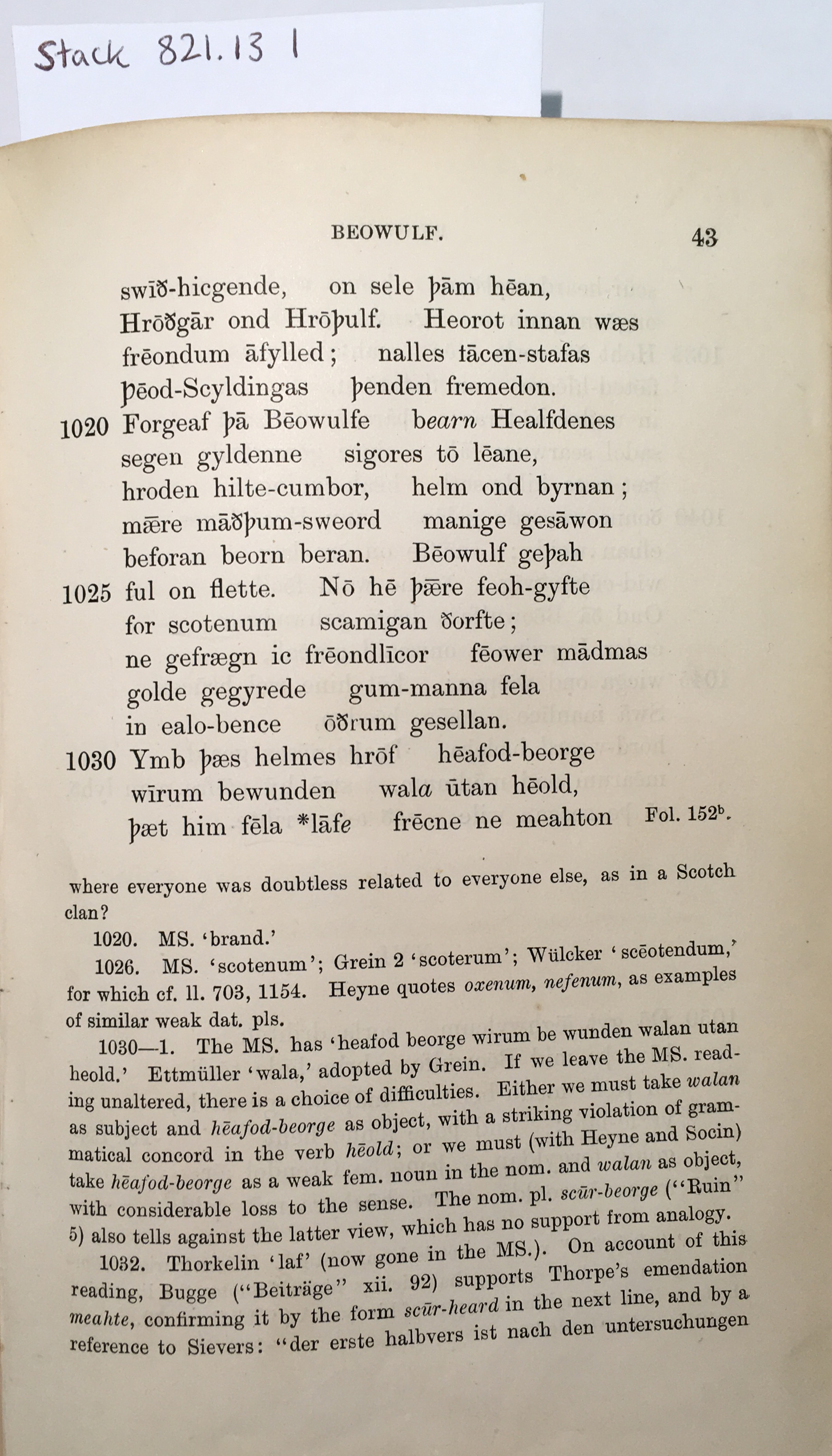
43
swīð-hicgende , ⁠       on sele þām hēan ,
Hrōðgār ond Hrōþulf .       ⁠ Heorot innan wæs
frēondum āfylled ; ⁠       nalles fācen-stafas
Þēod-Scyldingas ⁠       þenden fremedon .
1020 Forgeaf þā Bēowulfe       ⁠ b earn *

1020. MS. ' brand . '

Healfdenes
segen gyldenne       ⁠ sigores tō lēane ,
hroden hilte-cumbor , ⁠       helm ond byrnan ;
mǣre māðþum-sweord ⁠       manige gesāwon
beforan beorn beran . ⁠       Bēowulf geþah
1025 ful on flette . ⁠       Nō hē þǣre feoh-gyfte
for scotenum *

1026. MS. ' scotenum ' ; Grein 2 ' scoterum ' ; Wülcker ' scēotendum , ' for which cf. ll . 703 , 1154. Heyne quotes oxenum , nefenum , as examples of weak dat . pls .

      scamigan ðorfte ;
ne gefrægn ic frēondlīcor       ⁠ fēower mādmas
golde gegyrede       ⁠ gum-manna fela
in ealo-bence       ⁠ ōðrum gesellan .
1030 Ymb þæs helmes hrōf ⁠       hēafod-beorge
wīrum bewunden       ⁠ wal a ūtan hēold , *

1030-1 . The MS. has ' heafod beorge wirum be wunden walan utan heold . ' Ettmüller ' wala , ' adopted by Grein . If we leave the MS. reading unaltered , there is a choice of difficulties . Either we must take walan as subject and hēafod-beorge as object , with a striking violation of grammatical concorn in the verb hēold ; or we must ( with Heyne and Socin ) take hēafod-beorge as a weak fem . noun in the nom . and walan as object , with considerable loss to the sense . The nom . pl. scūr-beorge ( " Ruin " 5 ) also tells against the latter view , which has no support from analogy .

þæt him fēla *

1032. Thorkelin ' laf ' ( now gone in the MS. ) . On account of this reading , Bugge ( " Beiträge " xii . 92 ) supports Thorpe's emendation meahte , confirming it by the form scūr-heard in the next line , and by a reference to Sievers : " der erste halbvers ist nach den untersuchungen Sievers ' ( " Beiträge " x . 455 ) metrisch unrichtig . " It is a curious commentary on this last reason , that Sievers himself quotes the line , with the form lāfe , among the examples of his type A ( " Beit . " x . 273 ) .

⁠ lāfe       ⁠ frēcne ne meahton
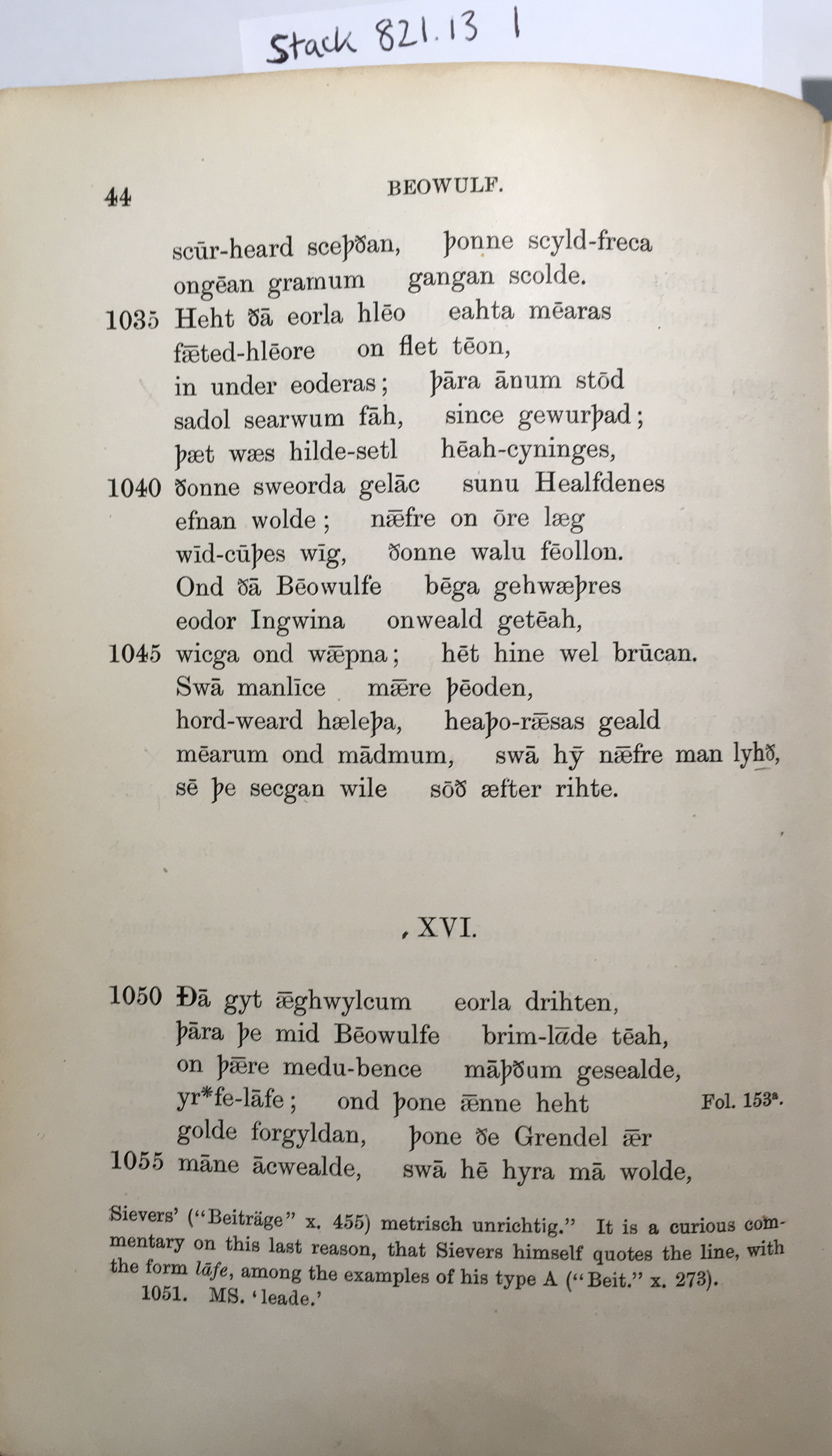
44
scūr-heard sceþðan ,       ⁠ þonne scyld-freca
ongēan gramum ⁠       gangan scolde .
1035 Heht ðā eorla hlēo ⁠       eahta mēaras
fǣted-hlēore       ⁠ on flet tēon ,
in under eoderas ; ⁠       þāra ānum stōd
sadol searwum fāh , ⁠       since gewurþad ;
þæt wæs hilde-setl ⁠       hēah-cyninges ,
1040 ðonne sweorda gelāc ⁠       sunu Healfdenes
efnan wolde ;       ⁠ nǣfre on ōre læg
wīd-cūþes wīg , ⁠       ðonne walu fēollon .
Ond ðā Bēowulfe       ⁠ bēga gehwæþres
eodor Ingwina ⁠       onweald getēah ,
1045 wicga ond wǣpna ;       ⁠ hēt hine wel brūcan .
Swā manlīce ⁠       mǣre þēoden ,
hord-weard hæleþa ,       ⁠ heaþo-rǣsas geald
mēarum ond mādmum , ⁠       swā hȳ nǣfre man lyhð ,
sē þe secgan wile ⁠       sōð æfter rihte .

About this text

Title: Beowulf
Author: Wyatt, A. J. (Alfred John), 1858-1935
Edition: Taylor edition
Series: Taylor Editions: Guest
Editor: Edited by Duncan Jones.

About this edition

This is a facsimile and transcription of Beowulf. It is held by St Anne's College Library (shelf mark Stack 821.13 1) and by the Taylor Institution Library (shelf mark 16.A.7).

The transcription was encoded in TEI P5 XML by Duncan Jones.

Availability

Publication: Taylor Institution Library, one of the Bodleian Libraries of the University of Oxford, 2019. XML files are available for download under a Creative Commons Attribution-ShareAlike 4.0 International License . Images are available for download under a Creative Commons Attribution-NonCommercial-NoDerivatives 4.0 International License .

ORA download

Source edition

Wyatt, A. J. (Alfred John), 1858-1935 Beowulf edited with textual foot-notes, index of proper names, and alphabetical glossary, by A. J. Wyatt, M.A. Lond., B.A. Cantab. Cambridge : At the University Press, 1894  

Editorial principles

Created by encoding transcription from printed text.

This edition is semi-diplomatic and has been designed to accompany the Kelmscott edition The Tale of Beowulf. Wyatt's numbered headers have been omitted as they do not correspond to the Kelmscott edition and could cause confusion. Printed erratum from the front pages of the edition have been fixed. All footnotes are as found in the Wyatt text.