Facsimile
Transcription
[NOTE : This translation is based on the Leipzig print , Arch. 8o . G . 1518 ( 6 ) and is reproduced here for the reader's convenience . Although the two texts are very similar , there are some differences , which are noted in the footnotes to the transcriptions .]
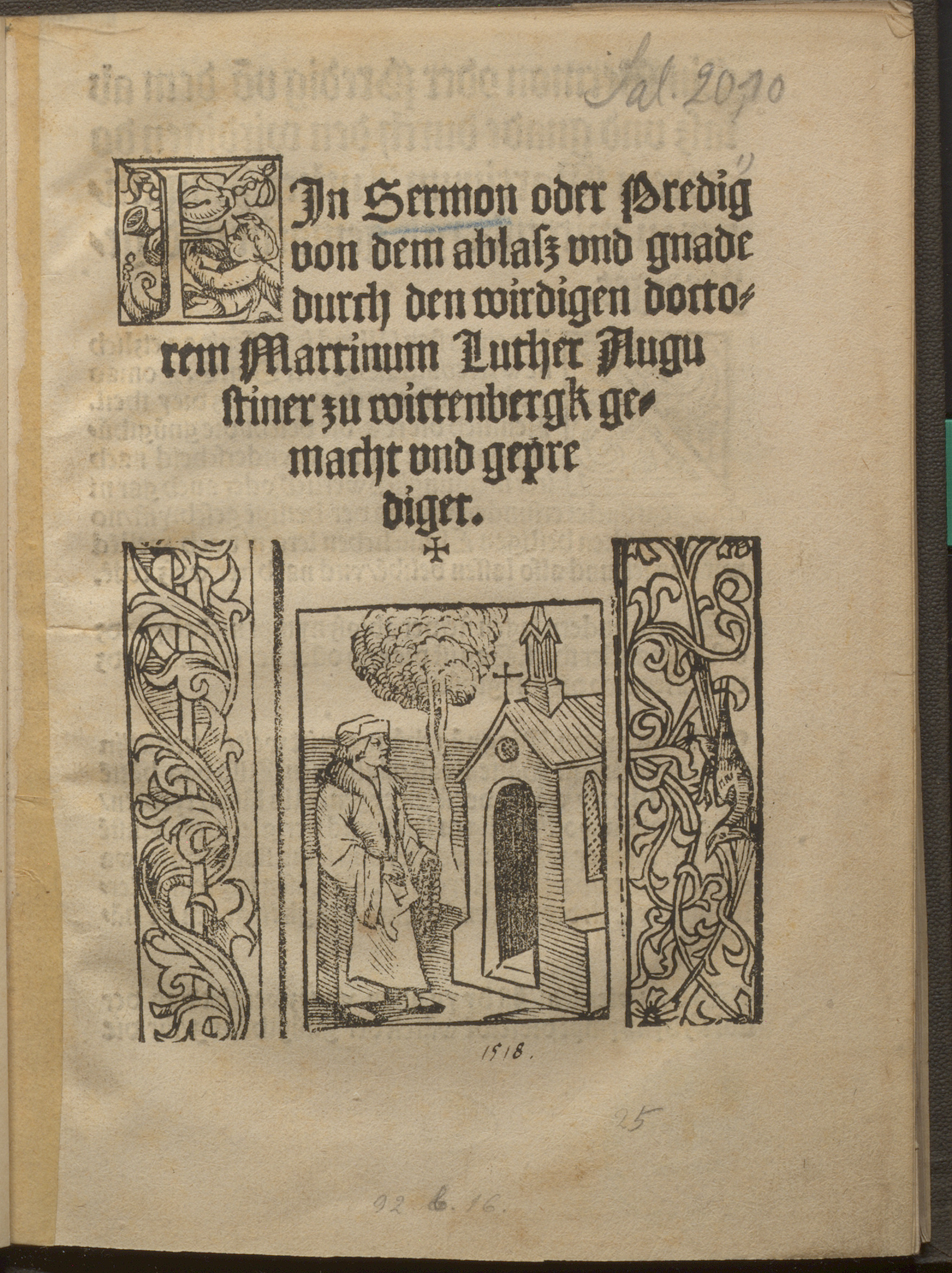
A Sermon on Indulgences and Grace Composed by the Esteemed Doctor Martin Luther of the Augustinian Order , Wittenberg
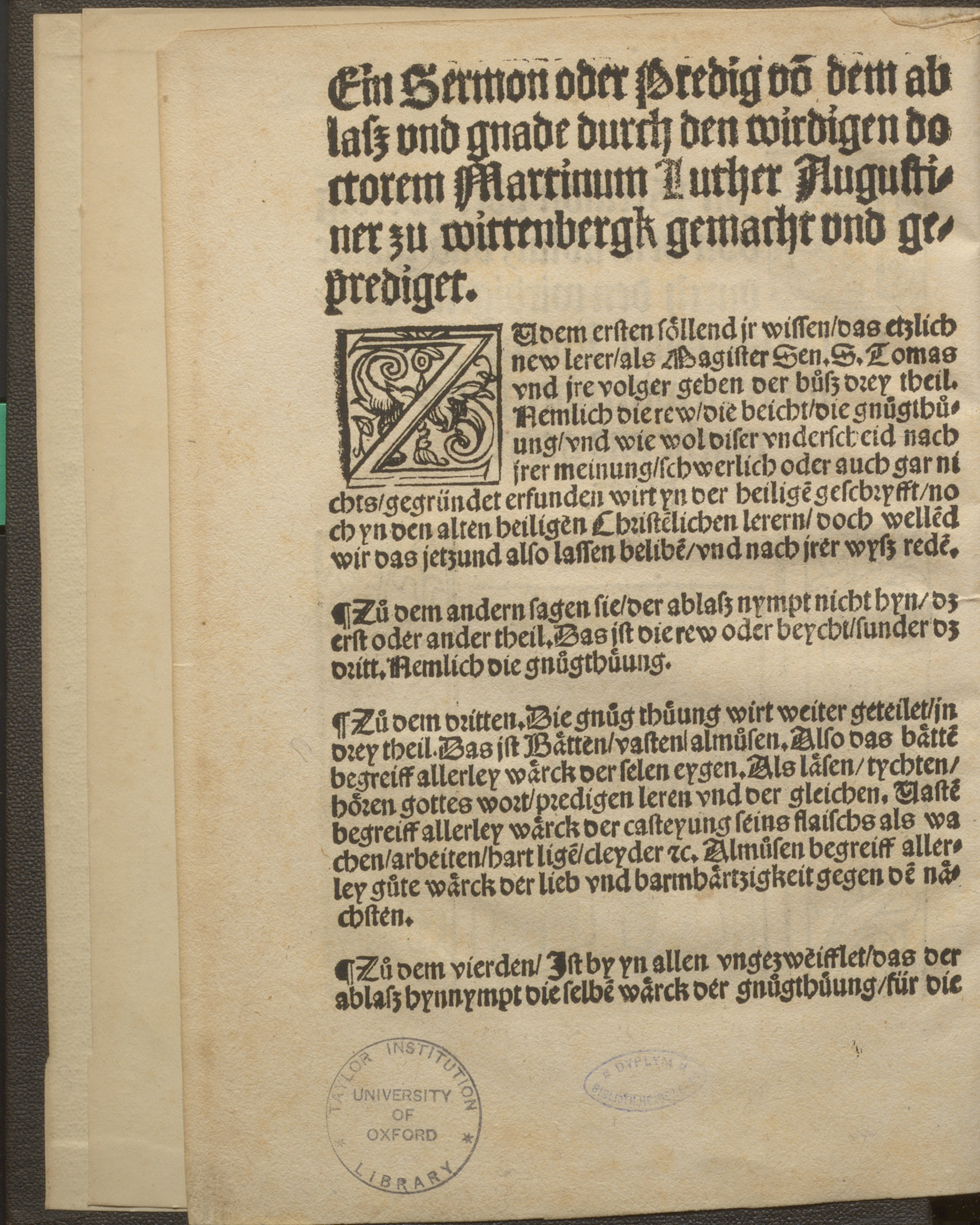
A Sermon on Indulgences and Grace Preached by the Esteemed Doctor Martin Luther of the Augustinian Order , Wittenberg .
1. You should know that several recent teachers , such as the Magister Sententiarum Peter Lombard , St Thomas Aquinas , and their followers divide penance into three parts , namely contrition , confession , satisfaction . 11 Peter Lombard ( 1096 – 1160 ) and Thomas Aquinas ( 1225 – 74 ) . Peter Lombard’s title of Magister Sententiarum ( ‘ Master of Sentences ’ ) refers to his work The Four Books of Sentences , still a standard theology textbook in Luther’s time . On the theological background to the Sermon , see Introduction . And although it is scarcely , if at all , possible to find a basis for this distinction of theirs in Holy Scripture or the ancient holy Christian teachers , we shall nevertheless pass over this for now and discuss the matter in their terms . 22 In the German version each point is introduced by an ordinal number written in words ( ‘ Firstly ’ to ‘ Twentiethly ’ ) . These words are sometimes integrated grammatically into the point itself by being followed immediately by a finite verb ( as in ‘ Czum Neunden / Sag ich … ’ , literally : ‘ Ninthly say I … ’ ) . Since this type of inversion is not possible in modern English we simply number the points ‘ 1 ’ to ‘ 20 ’ .
2. They say that indulgences do not cancel the first or second parts , that is , contrition or confession , but the third , namely satisfaction ..
3. Satisfaction is further divided into three parts , which are prayer , fasting , almsgiving . 33 These three parts are taken from the Sermon on the Mount ( Matthew 6 : 1 – 18 ) . Thus , prayer includes all manner of works proper to the soul , such as devotional reading and writing , listening to the word of God , preaching , teaching , and the like . Fasting includes all types of work requiring mortification of one’s flesh , such as vigils , toil , a hard bed and clothes , etc. Almsgiving includes all types of good work involving love and charity towards one’s neighbour .
4. None of them doubts that indulgences cancel those works of satisfaction which we are bound to do , or which are imposed on us , for sin . 44 Luther is referring here to temporal penalties imposed by the church either according to canon law or , if the sin was not explicitly provided for in canon law , at the discretion of the confessor . For if indulgences were to cancel these works altogether , there would be no good left that we could do .
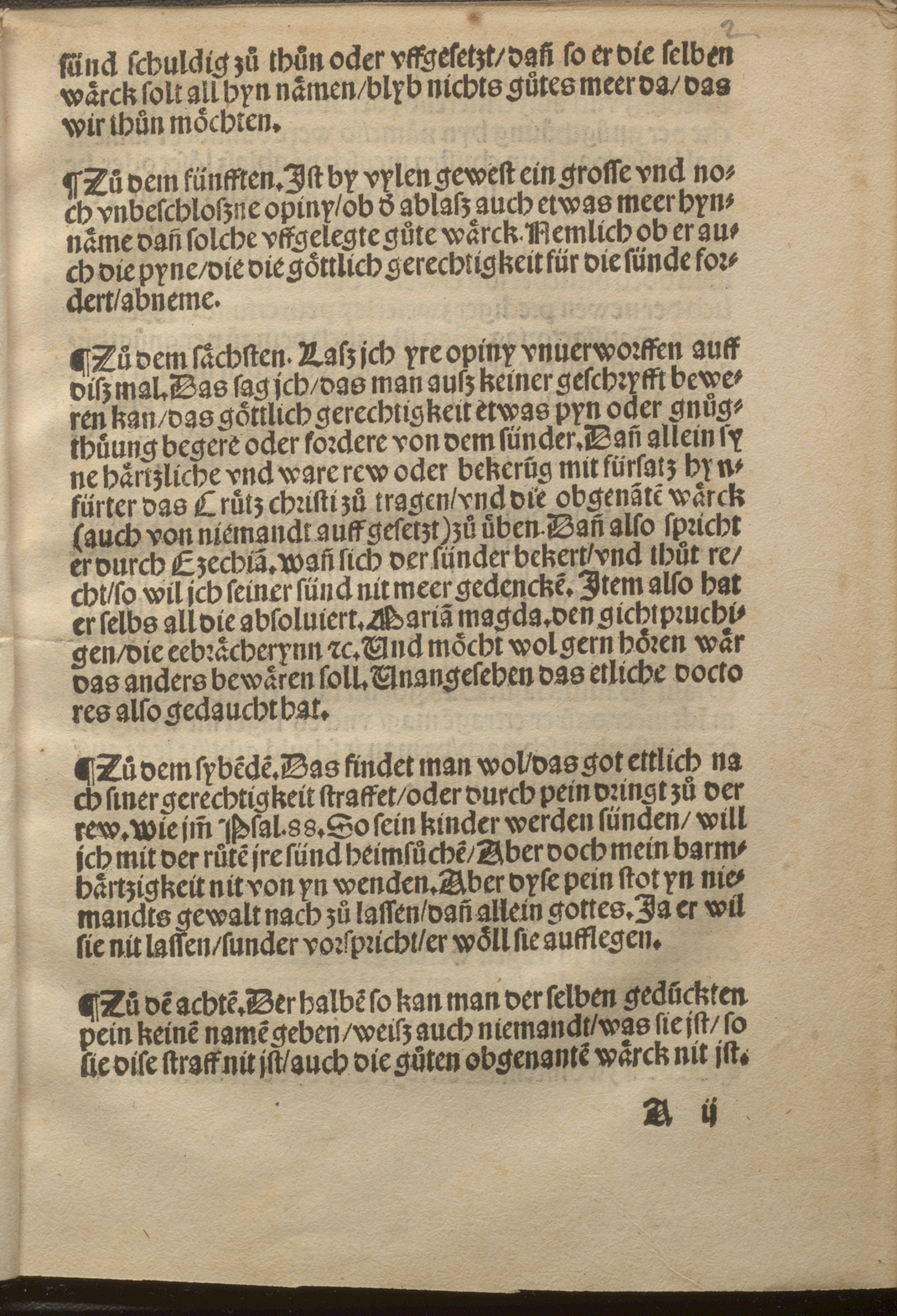
a2r 5. Among many of them there has been a strongly held opinion – and it is still not decided – about whether indulgences take away more than those good works which are imposed , that is , whether they also take away the punishment 55 The word ‘ peyn ( e ) ’ , which has the sense of both ‘ punishment ’ and ‘ suffering ’ , has been translated as ‘ punishment ’ throughout the Sermon ; cf. thesis 4 in the 95 Theses and the note to it in this edition . which God’s righteousness demands for sin .
6. I will put off a rebuttal of their opinion for the time being , and I will say only this : 66 Luther offers more arguments against this claim in the 95 Theses ; see , for example , theses 20 , 26 , and 28. It cannot be proved from any part of Holy Scripture that divine righteousness desires or demands any punishment or satisfaction from sinners except only for their heartfelt and true contrition , or their turning away , 77 i.e. from sin . with the intention of bearing the cross of Christ 88 See Matthew 16 : 24. and performing the above-mentioned works from then on ( even if not imposed by anyone ) . For , as He says through Ezekiel , ‘ If the sinner turns away and does right , I will no longer remember his sin ’ . 99 This is a paraphrase of Ezekiel 18 : 21 – 22. And likewise there are all those He absolved Himself : Mary Magdalene , the man sick with palsy , the woman taken in adultery , etc. 1010 The three episodes referred to can be found in Luke 7 : 36 – 50 , Mark 2 : 1 – 12 , and John 8 : 1 – 11 , respectively . The first episode tells of the anointing of Jesus by a woman who is not named but was traditionally taken to be Mary Magdalene . And I would very much like to hear anyone prove otherwise – regardless of the fact that quite a few doctors of theology have supposed this .
7. It is true that God does punish several people according to His righteousness , or through punishment forces them to contrition , as in Psalm 88 : ‘ If his children sin , I will punish their sins with the rod , yet I will still not turn my mercy away from them ’ . 1111 Psalm 88 : 31 – 34 ( Vulgate ) ; Psalm 89 : 30 – 33 ( King James Version ) . Luther appears to misquote the Psalm , which has ‘ him ’ rather than ‘ them ’ ( including in Luther’s own Bible translations ) . But the power to set aside this punishment belongs to no-one but God alone . In fact He does not wish to set it aside but affirms that He wishes to impose it . 1212 Luther is using Psalm 88 as an example in which God does choose to punish sin according to His righteousness .
8. So therefore it is impossible to give a name to that supposed punishment , and no-one knows what it is if it is not the punishment just mentioned nor the good works referred to above . 1313 Luther’s point here is that , since the divinely imposed punishment mentioned in 5 , which is supposed to be cancelled by indulgences , is neither the punishment in 7 nor the good works in 3 , it cannot be identified . I will say this , that even if the Christian church decided and proclaimed today that indulgences cancel out more than the works of satisfaction , it would still be a thousand times better if not one Christian bought an indulgence or wanted one , and that they preferred to perform works and suffer punishment instead . For indulgences are nothing , and can become nothing , other than a setting aside of the good works and salutary punishment which one would do better to embrace than avoid – even though some of the recent preachers have invented two kinds of punishments , ‘ medicativae ’ and ‘ satisfactoriae ’ , that is , some for satisfaction and some for improvement . 1414 Luther is referring to Johann Tetzel and Konrad Wimpina whose 106 theses , which were a response to Luther’s 95 Theses , were publicly defended at the University of Frankfurt an der Oder on 15 January 1518. In those theses , Tetzel and Wimpina argue for the distinction between rehabilitation ( ‘ medicativae ’ ) and retribution ( ‘ satisfactoriae ’ ) which Luther attacks here . See Introduction , p. xxxiv . But we are , praise God , more at liberty to ignore this sort of prattle than they are to make it up : all punishment , indeed everything that God burdens us with , is for the improvement and benefit of Christians .
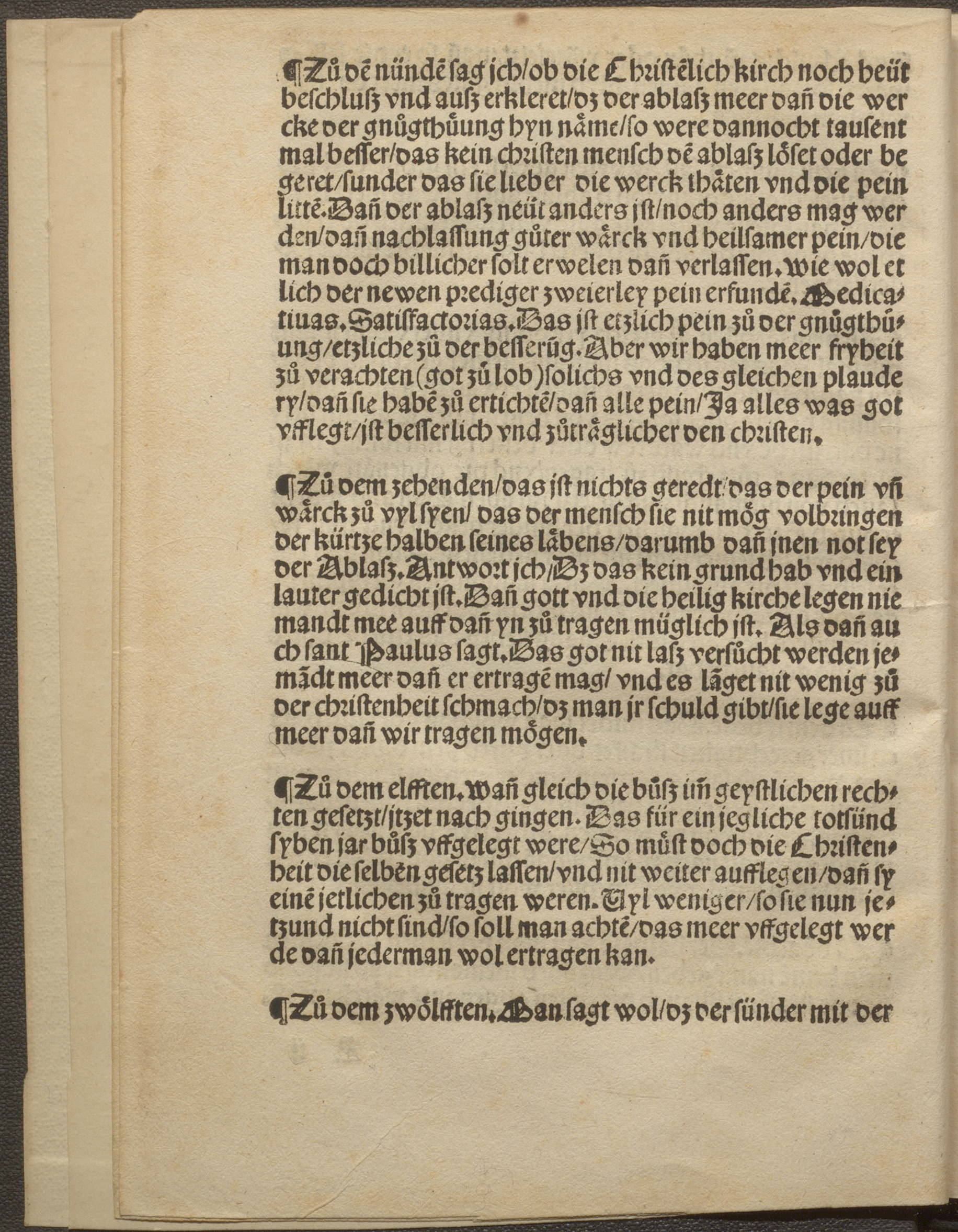
a2v 9. I will say this , that even if the Christian church decided and proclaimed today that indulgences cancel out more than the works of satisfaction , it would still be a thousand times better if not one Christian bought an indulgence or wanted one , and that they preferred to perform works and suffer punishment instead . For indulgences are nothing , and can become nothing , other than a setting aside of the good works and salutary punishment which one would do better to embrace than avoid – even though some of the recent preachers have invented two kinds of punishments , ‘ medicativae ’ and ‘ satisfactoriae ’ , that is , some for satisfaction and some for improvement . 1414 Luther is referring to Johann Tetzel and Konrad Wimpina whose 106 theses , which were a response to Luther’s 95 Theses , were publicly defended at the University of Frankfurt an der Oder on 15 January 1518. In those theses , Tetzel and Wimpina argue for the distinction between rehabilitation ( ‘ medicativae ’ ) and retribution ( ‘ satisfactoriae ’ ) which Luther attacks here . See Introduction , p. xxxiv . But we are , praise God , more at liberty to ignore this sort of prattle than they are to make it up : all punishment , indeed everything that God burdens us with , is for the improvement and benefit of Christians .
10. This is not to say that punishments and works are excessive , that nobody can complete them because of the shortness of life , and so they need indulgences . 1515 Here Luther is attacking another claim made in Tetzel’s and Wimpina’s 106 theses . My response is that this is unfounded and a pure fabrication . For God and the holy Church do not burden anyone with more than is bearable for them . As St Paul also says , God does not allow anyone to be tested beyond what they can endure , 1616 1 Corinthians 10 : 13. and it is no small disgrace to Christianity that it is accused of burdening us with more than we can bear .
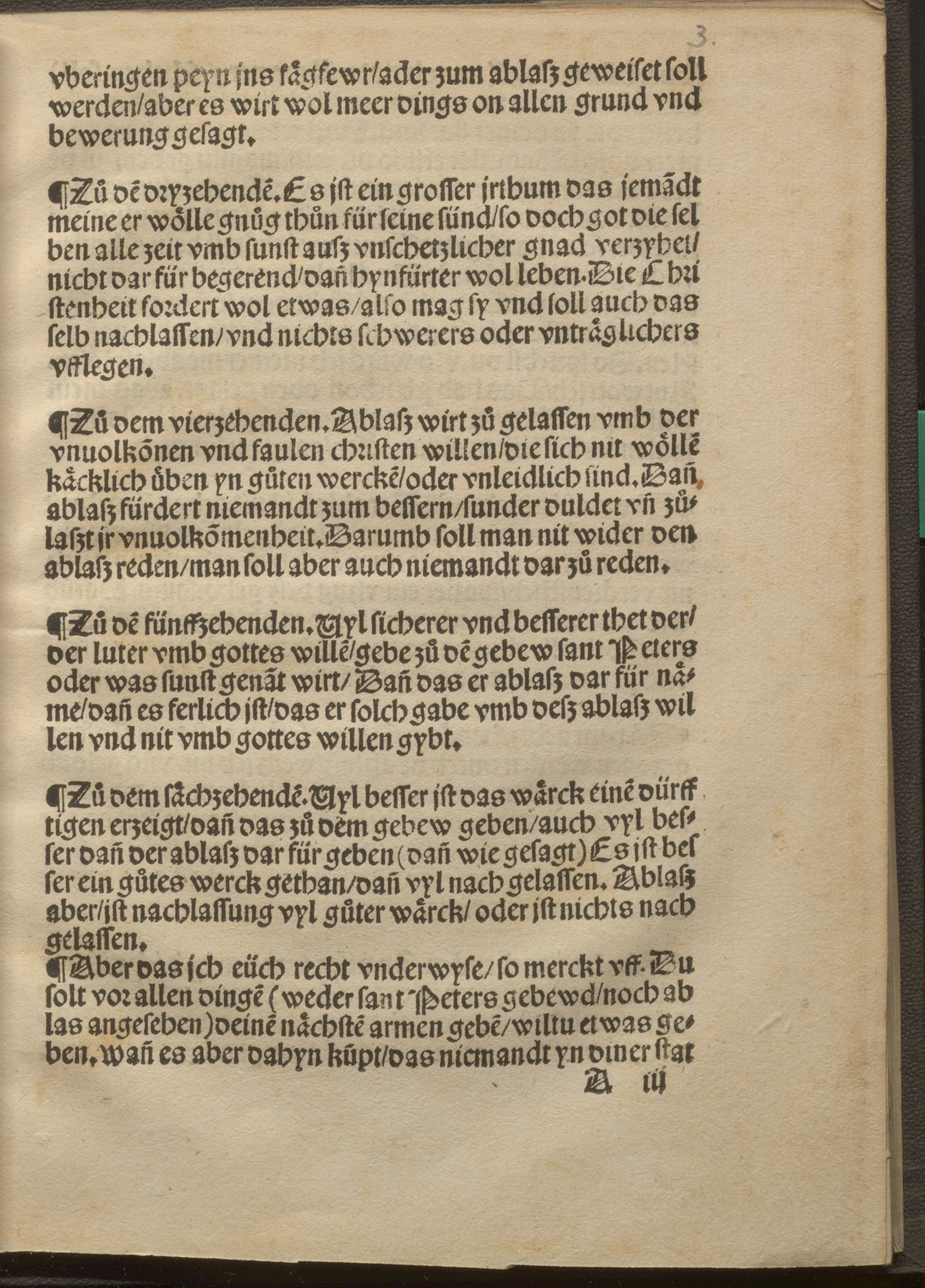
11. Even if the penitential rules laid down in canon law were still in force today , which imposed seven years ’ penance for each mortal sin , Christianity would still have to waive these laws and not enforce them beyond what is bearable for each person . Far less , now that these rules are no longer in force , should one think of burdening anyone with more than they can readily bear . 1717 The Leipzig print has ‘ nicht ’ ( ‘ not ’ ) here , which would give the sense , ‘ Far less , … , should one think of not imposing … ’ . This has been omitted in translation .
a3r 12. People do claim that sinners with punishment still outstanding should be shown the way towards purgatory or towards indulgences , but a great deal more is also claimed which is without foundation and proof .
13. It is a grave error for anyone to think that they should aim to make satisfaction for their sins , when in fact God in His unfathomable grace always forgives those sins for free , desiring nothing in return except to live a good life from then on . Christianity does make demands of its own , so it can and should set these aside as well , rather than burdening people with anything harsh or unbearable .
14. Indulgences are permitted for the sake of those imperfect and idle Christians who are none too keen to do good works or cannot bear suffering , for indulgences do not help people to improve , but tolerate and condone imperfection in them , so while one should not speak against indulgences , one should not recommend them to anyone either .
15. If one were to make a donation for the building of St Peter’s or for whatever other cause is proposed , it would be far safer and better to do so purely for God’s sake than to take an indulgence for it , for it is unsafe to make a gift like that for the sake of an indulgence and not for God .
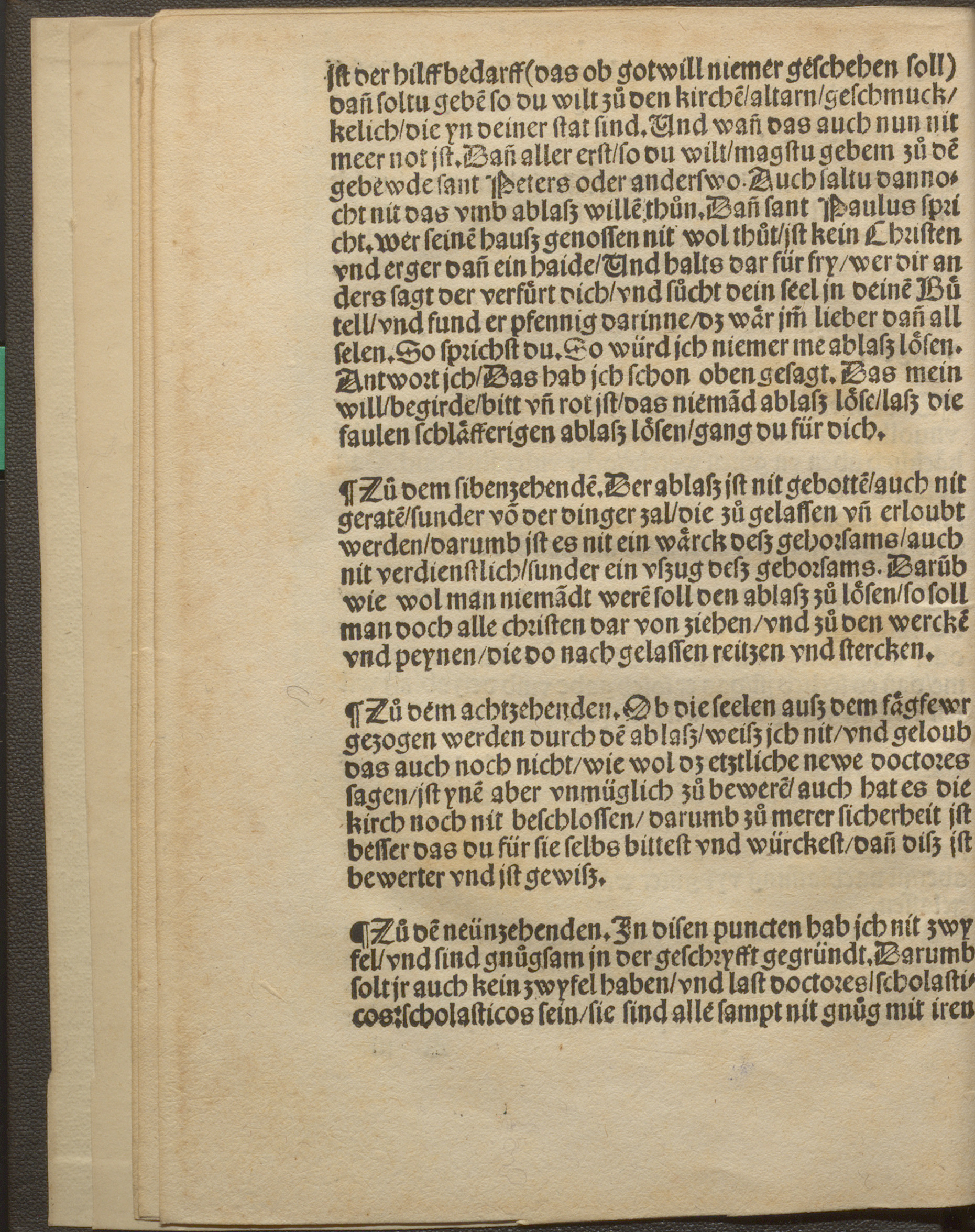
16. Far better is the work done for someone in need than as a donation for a building , and far better than the indulgence given for it since , as stated before , one good work done is better than many avoided . Yet indulgences are the avoidance of many good works if they are the avoidance of anything . Now pay attention so that I can give you clear instructions : If you want to make a gift , you should do so first and foremost ( leaving aside the building of St Peter’s and indulgences ) to a neighbour in need . But if it comes to the point that there is no-one left in your town who needs help – which , God willing , is never going to happen – then , if you wish to make a donation , you must make one for the churches , altars , ornaments , chalices in your town . And if there is no longer a need for that either , then , and only then , if you wish , may you give something for the building of St Peter’s or elsewhere . a3v But even this you should not do for the sake of an indulgence . As St Paul says , ‘ He who does not provide for those in his own household is no Christian and is worse than an infidel ’ . 1818 A slightly abbreviated quotation from 1 Timothy 5 : 8. Feel free to assume that anyone who tells you otherwise deceives you or is looking for your soul in your purse , and would be happier to find a penny there than any number of souls . You will say , ‘ In that case I shall never buy an indulgence again ’ . My response : ‘ As I have already said above , it is my wish , desire , plea , and advice that no-one buy an indulgence . Let lazy and lie-abed Christians buy indulgences : you follow your own path . ’
17. Indulgences are neither required nor recommended , but are among those things which are admissible and allowed , so an indulgence is neither an act of obedience nor meritorious , but an exemption from obedience . Therefore , even though one should not stop anyone from buying indulgences , 1919 By making this claim Luther may have been trying to keep within the rules of the Instructio summaria against impeding the sale of indulgences ; see Introduction , p. xxxvi and see thesis 73 and note . one should still pull all Christians away from them , and spur them on and strengthen them for the works and punishments which are reduced thereby .
18. Whether souls are rescued from purgatory by indulgences , I do not know , nor do I even believe it , although this is what several contemporary theologians say . 2020 On the doctrine which allowed indulgences to apply to souls in purgatory , see Introduction , pp. xviii-xix . Yet it is impossible for them to prove this , and the church has still not decided the matter , so to be on the safe a4r side it is better for you to pray and do works for them 2121 i.e. souls in purgatory . yourself – this is , after all , more reliable and is certain .
19. I have no doubt about these points , which have ample foundation in Scripture . So you should have no doubt either , and you should leave scholastic theologians to be scholastic . The whole lot of them together , with their opinions , could not add anything constructive to a single sermon .
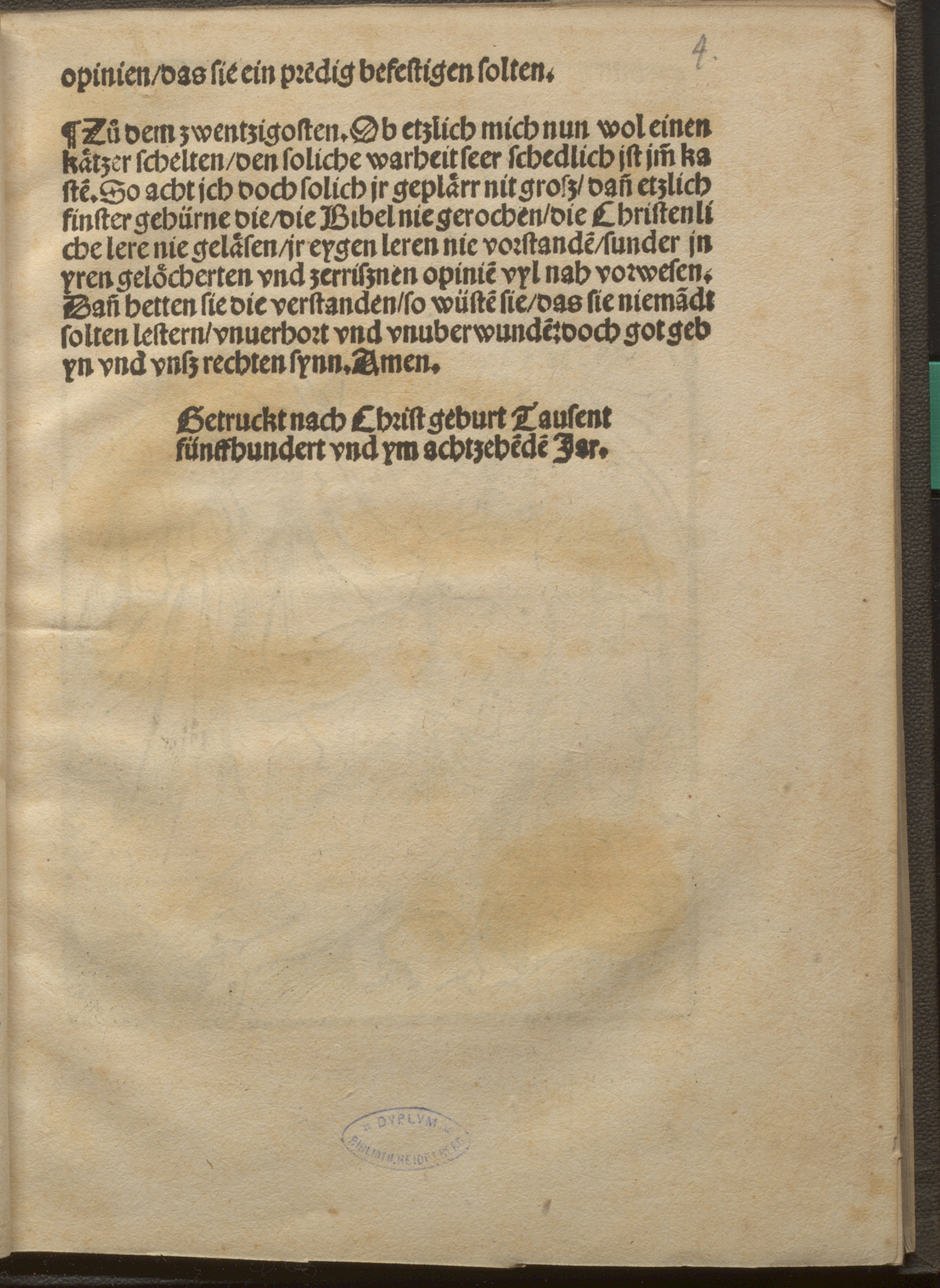
20. Even though I may well be branded a heretic by a number of people 2222 See Introduction , p. xxxiv , for who these people might be . whose coffers are seriously damaged by these truths , I don’t pay much attention to such blather , especially since the only ones doing this are certain dark minds who have never been within smelling distance of the Bible , never read the Christian teachers , never understood their own teachers , but , under their tattered , threadbare opinions , are all but wasting away . For if they had understood them , they would know not to defame anyone without hearing them out or countering them . Even so , may God give them and us a right understanding ! Amen .
Translation
About
About this text
Identification
Oxford, Taylor Institution Library, ARCH.8o.G.1518 (5)L 6268Other Resources
About this edition
This is a facsimile and translation of Eyn Sermon von dem Ablass vnnd Gnade. Luther, Martin, and Valentin Schumann | Leipzig: [Valentin Schumann], 1518. It is held by the Taylor Institution Library (shelf mark: ARCH.8o.G.1518(6)). Verzeichnis der im deutschen Sprachbereich erschienenen Drucke des 16. Jahrhunderts (VD 16) reference number: L6270.
The translation has been created by Howard Jones, and encoded in TEI P5 xml by librarian Emma Huber.
Availability
Publication: Taylor Institution Library, one of the Bodleian Libraries of the University of Oxford, 2018. XML files are available for download under a Creative Commons Attribution-ShareAlike 4.0 International License  . Images are available for download under a Creative Commons Attribution-NonCommercial-NoDerivatives 4.0 International License
  .
.
Source edition
Luther, Martin, 1483-1546; Gengenbach, Pamphilus Eyn Sermon Von Dem Ablass Vnnd Gnade. [Sermon on Indulgences and Grace.] Basel: [Pamphilus Gengenbach], 1518Downloads
Facsimile
Images are available for download under a Creative Commons Attribution-NonCommercial-NoDerivatives 4.0 International License .
Images
- Image #1 (JPG - 1.5M)
- Image #2 (JPG - 1.7M)
- Image #3 (JPG - 1.5M)
- Image #4 (JPG - 1.7M)
- Image #5 (JPG - 1.6M)
- Image #6 (JPG - 1.8M)
- Image #7 (JPG - 1.3M)
- Image #8 (JPG - 1.7M)
All Images (ZIP - 96M)
All Images (PDF - 31M)
Text
XML files are available for download under a Creative Commons Attribution-ShareAlike 4.0 International License .